Sun. May 3rd, 2026

Search Results for ‘(“C’

Home Forums Search Search Results for '("C'

Viewing 15 results - 4,171 through 4,185 (of 9,569 total)
  • Author
    Search Results
  • #20759
    Mike Nolan
    Keymaster

      bulkfoods.com has yellow split peas at a little over $2 per pound for five pounds, plus shipping. They're in Chicago, so shipping to Indiana may be reasonable. If you order $75 or more from them, shipping is just $5. I get citric acid powder from them (I use it in the dishwasher, among other things) and it isn't hard for me to hit $75.

      Unfortunately, they don't carry medium rye flour, which is what I'm currently shopping for. Many of the recipes in The Rye Baker call for medium rye flour, and it looks like if I do all 78 recipe just once I'll need somewhere between 50 and 150 pounds of it. I haven't checked the local Sysco office yet, so I don't know if they stock it, but I can get it online for about $1.35 a pound (in a 50 pound bag), including shipping. Not surprisingly, the shipping is more expensive than the flour. If I can wait until summer, I may be able to get my son to pick up a big bag from Stover Company near Pittsburgh for under $21, if they decide to drive out here for their usual summer visit.

      Honeyville has yellow split peas, 25 pounds for 40.99, and they now offer $6.99 flat rate shipping. That would bring the cost for 50 pounds of medium rye flour for me down to about $1.24 a pound. Sara Wirth used to order from them a lot, I don't know if she still does, both of you are in their truck route area.

      #20751
      Mike Nolan
      Keymaster

        Ash content is measured by burning the flour and measuring how much ash is left over. The ash comes mainly from the bran, germ and outer part of the endosperm.

        If a flour is 100% starch from the inner endosperm, the ash content is low, Calvel's book says the finest quality French flours, type 45, have an ash rate below 0.5% while whole meal flour is over 1.4%. Removing all the bran and germ is essentially impossible, no matter how finely you separate it (called bolting, because it originally used bolts of cloth), there's always going to be a little bran or germ left in the flour. So it measures the extent to which the flour is refined.

        Another way to think of ash rate is as the opposite of extraction rate, how much flour is extracted from the wheat berry, type 45 French flour or American patent flour has an extraction rate around 65%, a whole meal flour is in theory 100% extraction, but in practice more like 90-98% due to removing broken or immature berries, stones, twigs, etc. from the grain before grinding it.

        Since rye is not white in the middle, there isn't as much cosmetic value in extracting only the endosperm, so most rye flours are medium or dark flours. White rye flour is only the endosperm (or as little bran and germ as possible), and it isn't all that white.

        #20750

        In reply to: Artisan Bread Salt

        chocomouse
        Participant

          I guess I've not developed a discrete taste for milk! I don't taste milk, dry or otherwise, in anything. I was made to drink milk (always regular whole cow's milk) at meals when I was growing up. I hate it. I never drink it. I've not drank milk for over 50 years! I can tell the difference between 2% milk (which my husband drinks) and half and half or cream in chowders, and much prefer the half and half.

          #20730
          Mike Nolan
          Keymaster

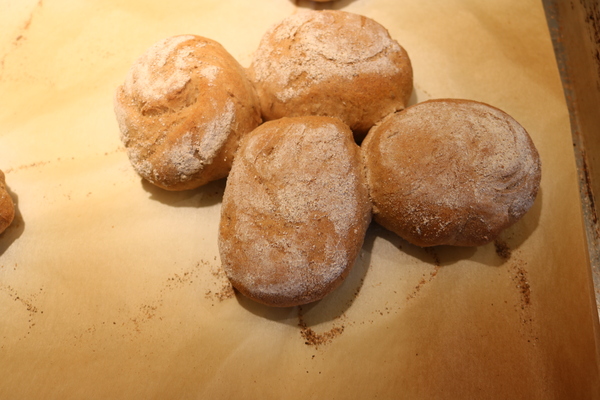
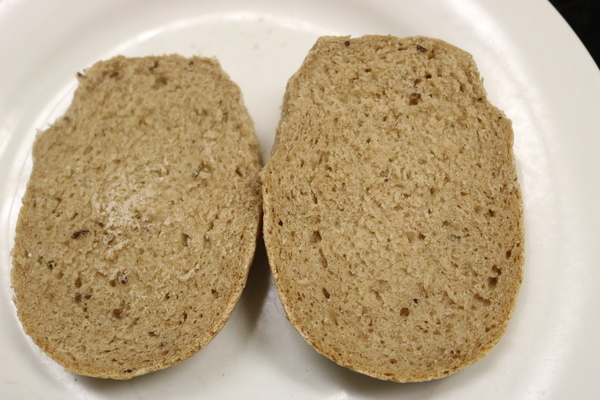
            Report on Munich Penny Rolls (The Rye Baker pps 198-201):

            munich-penny‑1

            This recipe made 16 rolls about 3 1/2 by 2 1/2 by 1 1/2 inches, with a variance of about 1/4 inch. They weighed 75 grams each (2.65 ounces).

            This is one of the recipes in The Rye Baker that lists first clear flour as an option in place of bread flour, and I used first clear flour in it. My experiences with other breads using first clear flour seem to suggest those breads can go moldy faster than ones made with bread flour, I don't know if that will be the case here yet.

            It calls for red rye malt, which you make by toasting rye malt. I got some chopped rye malt from a home brew supply store and ran it through my impact mill before toasting it.

            I had to add about 1/3 to 1/2 cup more of both rye and wheat flour than the recipe called for, not sure if that was a liquid measurement issue, and it took a while before the dough came together. This is the first recipe I've made where the scale weight (83 grams each) was above that suggested in the recipe. It didn't pull a very good windowpane, but it was pretty stiff after about 10 minutes of machine kneading, so I declared it ready. It rose well both in the bulk rising and after scaling and shaping.

            The rolls are baked in sets of four arranged as shown in the top picture. Ginsberg calls this a herringbone.

            They're a bit milder in flavor than I was expecting, but they taste very good plain, with a little butter, or as a sandwich roll. I haven't tried toasting them yet. I was expecting more of a crisp outer crust, it is stiff and a bit chewy (like a lot of sourdough breads), but not really crisp. Maybe they'll crisp up some overnight.

            I would make these again.

            munich-penny‑2

            Attachments:
            You must be logged in to view attached files.
            #20722
            RiversideLen
            Participant

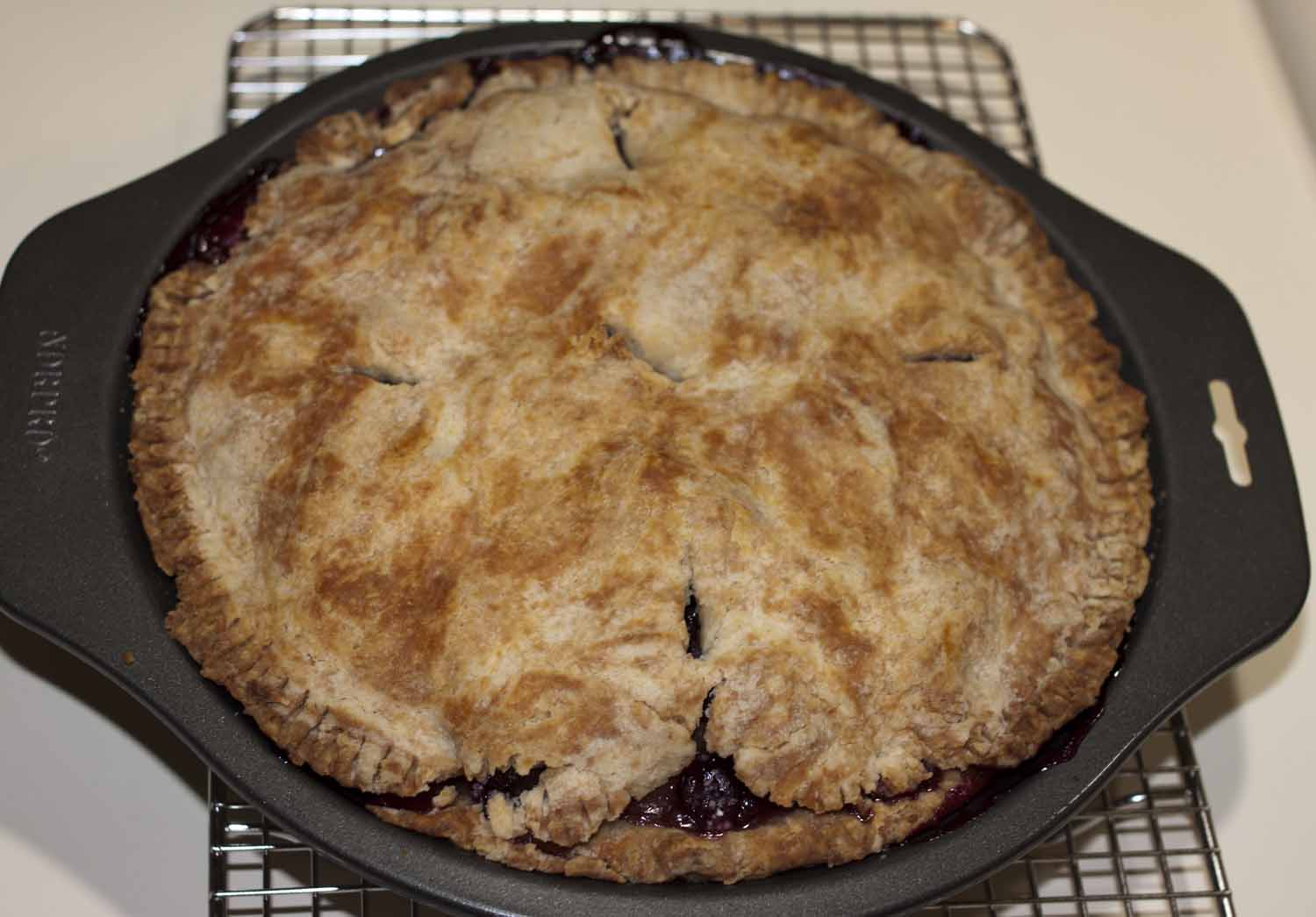
              I bought a Norpro non stick pie plate this past week so I had to make a pie. An apple/blueberry pie. I took 3 apples and cubed them, cooked them down a little with a little sugar and cinnamon, That is the bottom layer. One pint of blueberries tossed with some sugar and a squeeze of fresh lemon. That is the top layer. I made an oil crust using Jenny Jones recipe. I have used it before and found that one to be the easiest to use (2 1/2 cups of flour, a little sugar and salt, 1/2 cup each oil and milk - I used grapeseed oil).

              It just came out of the oven. It's not the prettiest because I made the top crust just a little too small. If it looks good after I slice it, I'll post another pic.

              Pie

              Attachments:
              You must be logged in to view attached files.
              #20721

              In reply to: Artisan Bread Salt

              Mike Nolan
              Keymaster

                KAF doesn't go into specifics about what makes it artisanal, other than it being higher in minerals than 'ordinary' salt. I guess that makes it a sea salt. (Some people claim that all salt is 'sea salt', and with some justification.)

                I know there are people who swear by a particular type of salt, such as French sea salt, Himalayan salt, Hawaiian salt, etc, but I can't really tell the difference between them in baking. Those may be the people who swear they can detect a bitter taste in iodized salt.

                We've been using sea salt in a salt grinder as our 'table salt' since the 70's, I think the added minerals do give it a different taste on food, I know we use less of it than we did table salt. But I can't taste the difference in baked goods. I do use pretzel salt on baked goods like pretzels, and it does make a difference as it is less likely to dissolve. I"m not sure why.

                As I have noted more times than I care to count up, Morton Salt recommends against using kosher salt when baking, because the larger crystal sizes might not dissolve and disperse in your dough as evenly as a finer grain salt. That hasn't dissuaded many baking authors from climbing on the kosher salt train.

                #20710
                RiversideLen
                Participant

                  In the past year or two, Alton Brown did several episodes of Good Eats, Reloaded (not to be confused with the new episodes). In those episodes he corrects or changes certain steps. For example, in a pasta episode he did the traditional method of using a lot of water to boil the pasta in. In the Reloaded episode he changes that to a minimal amount of water, about an inch over the pasta. In fact, he puts the pasta in the pot, then cold water and brings it up to a boil. I've been doing it that way and it works like a charm. It's faster because the pasta is cooking as the water comes up to temp and there is less water being heated. The texture and taste of the pasta is no different from the traditional method of cooking, at least to me although Alton says it makes better pasta.

                  I couldn't find that episode on YouTube but I did find this one in which he talks about the science of cooking pasta as well as some other items.
                  Alton Brown

                  If you have a streaming device, you can view all his episodes (original, reloaded and the return of) on the Food Network Go app.

                  I used to love the cooking channels until they became mostly competition shows. I am not amused by the fake drama and they don't teach anything.

                  #20709
                  Mike Nolan
                  Keymaster

                    UNL isn't one of the institutions in the Kernza project, so I'm not sure if I'll be able to get a sample of it to try, I've been trying to make a contact at KSU, which has a world-renown grains program. (When Prof. Raymond Calvel decided to take a sabbatical in the USA, he did it at KSU.) They run a number of week-long training programs, but they're a bit pricey, $1800 for the one on grain milling.

                    I've got some triticale coming this week from the grains researcher in my wife's department.

                    #20706
                    Mike Nolan
                    Keymaster

                      I always have mixed emotions on Alton Brown. I thought he sold out on The Food Network, I was glad to see him resuming Good Eats, though I haven't watched it much. (I don't watch The Food Network as much as I used to, just not much worth watching.)

                      Some of his ideas are interesting, others not so much. I tried his popovers recipe, WAY TOO SALTY! Susan Reed at KAF was one of his instructors in cooking school, she says he knew back then what he wanted to do in the kitchen after completing his training.

                      Kenji is always an interesting read, and I've found very few of his ideas I've disagreed with. His take on science is usually fun, too. Wish I was an invitee to some of his experimental dinners.

                      #20693
                      BakerAunt
                      Participant

                        I checked the yogurt after five hours, and it didn't seem quite set, so I let it go another hour, and it seems fine. I've refrigerated it and will try it at breakfast tomorrow. I also had the yogurt maker sitting on the cold counter until the last hour. It occurred to me that it was likely losing some heat, so I put it on one of those fold up "dish mats," which I've never used for dishes but have used for containers of dough for either rising.

                        One of my gripes with a lot of store yogurt is the added thickeners--pectin, food starch. I dislike how it feels in my mouth. I prefer my yogurt slightly creamy, which is why I liked Stonyfield regular and Chobani Greek yogurt. (I saw plain nonfat Stonyfield Greek yogurt in Walmart, but it was over $6 per carton.) Greek yogurt is higher in protein but lower in calcium, so it's a trade-off. A good yogurt should taste good without additives. Sometimes I stir in some of my homemade jam. Lately I've been sprinkling a bit of my homemade maple granola on my Chobani Greek yogurt, so I'll try it with the homemade yogurt.

                        Each jar is about 200mg calcium and 2g saturated fat.

                        #20691
                        Mike Nolan
                        Keymaster

                          Well, I toasted the malted rye after grinding it up, and it has an interesting fragrance. (I like it, my wife doesn't.) It does turn pink as you toast it.

                          #20689
                          Mike Nolan
                          Keymaster

                            The Wall Street Journal has an article up on the increased interest in the science of cooking. It notes that J. Kenji Lopez-Alt's book, The Food Lab, has more reviews on Amazon (with an average rating of five stars) than the 2019 edition of The Joy of Cooking. The article also has several quotes from McGee's On Food and Cooking.

                            Not sure if the article will come up for folks, but here's the link:

                            WSJ Article Link

                            BakerAunt
                            Participant

                              It’s 33F and snowing big wet snowflakes since this morning. It’s a good day to try making yogurt. I have a Kenmore Yogurella YM100 yogurt maker that I bought from Tuesday Morning, probably about five years ago and never used. I had the directions a few months ago, but now they are misplaced. I went online and had a difficult time finding a manual, but I found the directions, then read up on making yogurt using Google. I'm giving this project its own thread in case another poor soul out there is looking for that illusive instruction manual.

                              I have a nice All-Clad saucepan with heavy bottom that did well for heating 800ml of 1% milk, with 2 Tbs. Bob’s Red Mill milk powder whisked in before starting. The milk powder is supposed to make creamier yogurt when using low-fat milk. I saw 3-4Tbs. in some recipes and decided to start with 2Tbs. for my yogurt project.

                              I heated the milk to 190 (193 in the center), using a candy thermometer clipped to the pan, and Thermapen to check the center. I had read that it is a good idea to keep the milk at that temperature for about 10 minutes, so I did so. I used a high heat spatula to stir, but I was pleased that the pan kept the milk from sticking. I removed from the heat to allow it to cool down to about 108F. I left in the thermometer, so that I could keep an eye on it, and I covered the top of the pan with a tea towel and set it on a rack on the counter. When I would make yogurt years ago, the towel seemed to help prevent a skin from forming over the top. Note: the amount of milk is about one jar full (not counting the neck of the jar. This yogurt maker’s six jars have screw on lids—a big advancement over the snap on plastic lids of the past that would eventually split and be impossible to replace. The yogurt maker itself is a simple rectangle under a plastic rectangular domed top.

                              After 30 minutes, the temperature was at 137F. I stirred it, replaced the towel. After another 30 minutes, the temperature was 110F. I put a cup of the milk into a 2-cup glass measuring cup. I whisked in 170g (about ¾ cup) full-fat Stoneyfield yogurt, then added this mixture back into the milk in the pot, whisked it, and divided it between the six containers. The jars are not overly full. I might increase the milk by 50 ml next time. The jars are now in the yogurt warmer. The directions say 4-6 hours. I’ll check at 5 hours.

                              • This topic was modified 6 years, 3 months ago by BakerAunt.
                              • This topic was modified 6 years, 3 months ago by BakerAunt.
                              #20668
                              Mike Nolan
                              Keymaster

                                The nearest Penzey's is in Omaha, and I think I've been there only once. I've probably been to the one in the Strip District in Pittsburgh more than that. I"m not into pre-made spice blends and that seems to be a large part of Penzey's inventory these days.

                                I don't know if Lincoln is quite big enough to support a Penzey's. There's a new spice shop on this side of town that I haven't visited yet, they also do knife sharpening, which interests me. (I have been sharpening my own knives, I've got whetstones in 400/1000 and 3000/8000 grit levels, but I have some scissors that need sharpening.)

                                #20667
                                Mike Nolan
                                Keymaster

                                  I've tried a variety of steam methods over the years. What I've been doing lately is putting an 8" cast iron skillet in the oven when I turn it on, then I put the tea kettle on the stove. When the dough goes in the oven, I pour a cup or so of boiling water in the skillet. There's a big burst of steam, but much of it comes out the open door, I think. So I also take a sprayer and spray the side walls of the oven.

                                  I believe steam is even more important for free-form loaves, because there's a lot more dough surface area exposed to the open air, so there's more crust for the steam to impact.

                                  Several years ago I read something about a kit someone was selling that consisted of a heat-safe plastic tube that would attach to the oven door and lead down to a heavy metal pan inside, you could pour water in it and it would go into the pan while the oven was (mostly) closed. I assume it had some kind of funnel. I haven't found that reference lately. What I wasn't sure about is whether you took the tube out a few minutes later or if the oven door wound up being propped slightly open as a result.

                                  Several companies make a steam oven for home use, they're expensive and the reviews I've seen of them have been mixed. (Maybe it is just getting used to a new oven.) But I have no plans to replace my 48" DCS dual fuel range any time, and it'd be a major job anyway, we'd probably have to take out the center island temporarily.

                                  As I understand it, steam injectors in commercial ovens require periodic maintenance, cleaning out calcium buildup, etc. I assume there would be some ongoing maintenance on a home steam oven as well.

                                  My KA is making some noises every now and then that tell me the main gear may be going. I don't know if I can get a replacement for it, since we've had it since 1972. (It was a wedding present.)

                                  I've thought quite a bit about what to replace it with.

                                  KA makes several lines of mixers in each of their sizes, with different quality/durability levels, I'm sure. You probably have to check the motor rating to figure out which one it is. (Price is probably a good clue, too, if it is under $200 it probably isn't going to be the strongest motor.) From reviews on various sites, it seems KA has gone back to metal gears from the plastic ones, at least in some lines.

                                  KA also now offers a glass bowl option for their smaller mixers, but I hear it is very heavy and the base tends to chip where it hooks in, so I'm not sure it is worth the cost.

                                  Viking used to make an 8 quart mixer that got good reviews (they're what KAF had in their test kitchen when I visited it several years ago.) But they've gone out of the business. I've looked at a 12 quart commercial-grade countertop mixer a few times, but it's in the $1000 range.

                                  I've also looked at the Anksarsrum and similar mixers, I think I'd like to work with one before actually buying one.

                                  Not sure where I'd find the counter space, but if I had to replace it NOW and funds weren't a major object, I might go with a cheaper 4 1/2 or 5 quart KA just so I've got one for small batches and the 12 quart one for bigger stuff. That way I'd still be able to use my KA pasta attachments and the bowls I have.

                                  Has anybody tried the KA attachments on other brands of mixers that have an attachment port?

                                  I've made recipes that were in the 9 cup range in my 4 1/2 quart mixer, but what you have to do is add the flour and water in several stages so it doesn't slop over the side. Larger mixers tend to have a bowl shield that probably helps prevent spillovers. If you're doing a dough with a preferment (and I do a lot of those, especially the rye breads), you might have to add the preferment in several stages as well.

                                Viewing 15 results - 4,171 through 4,185 (of 9,569 total)