Some kind of bug damage on this maple? (We have someone trimming the trees, he didn't recognize it, but we have an arborist coming out later today, she should know what it is, probably some kind of gull from bugs.)
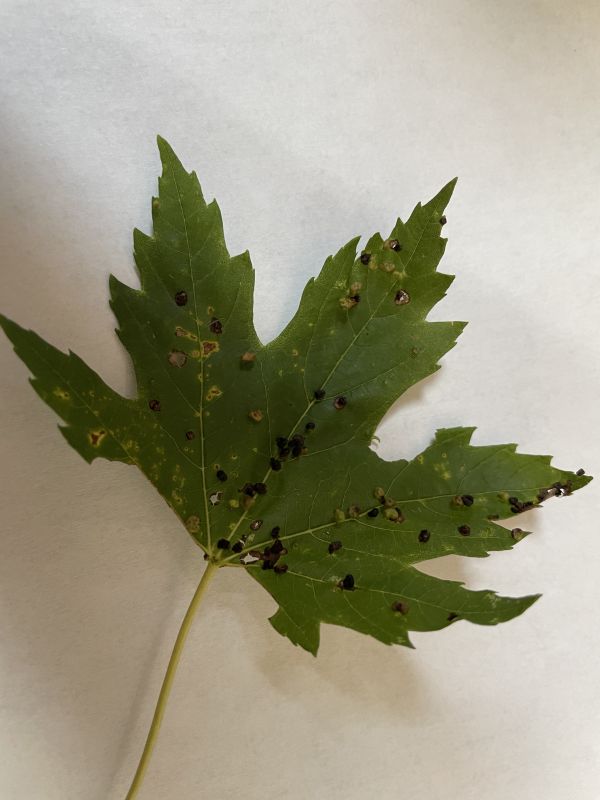
Attachments:
You must be
logged in to view attached files.
Ah, yes, Chocomouse, ginger with peaches! My recipe used 1/2 tsp. cinnamon and 1/4 tsp. nutmeg (I grate fresh). However, these muffins would be excellent with the addition of candied ginger in place of the nutmeg for a more assertive flavor.
I can also report that my tomato-zucchini tart warmed up well (350F for 10 min. in small oven) on a metal pie plate. Indeed, I think it is better today than when it was first baked.
Yes, BakerAunt, those my Lodge cast iron, 8.4" x 4.5"; I use them for all my yeast breads, only once in a while using the long oval covered baker.
I have a peach coffee cake in the oven now. I sort of used a recipe I found online after much searching. I used 4 large, juicy peaches, and Greek yogurt, and added cinnamon and ginger to the batter. I put down a layer of batter (with chopped peaches folded in) and then a layer of cinnamon streusel, and a top layer of batter. It smells divine, and luckily, unlike yeast breads, I don't have to wait until it has cooled to cut a generous taste test!
Those loaves look good, Chocomouse. Are those your iron bread pans?
On Monday morning, I baked Oat & Peach Muffins, a recipe from Muffin Magic [Ryland, Peters, and Small, 2010], pp. 24-25. It was one of those little cookbooks with pretty pictures that ended up in the discount section. I found it a few years ago, back when I still lived near a bookstore where I could browse. It had a few recipes I thought made it worth my while, and when we were packing up the guest quarters for the now ongoing renovation, I found it and set it aside to try some recipes. I had some leftover frozen peaches, as I had had to buy some ringers to supplement the fresh ones when I made jam a couple of weeks ago, so this recipe was a good fit. I made a few changes in that I reduced the brown sugar from ½ cup plus 2 Tbs. to 1/3 cup, the largest amount I usually use in a muffin. I replaced 1/3 of the AP flour with white whole wheat and added 1 Tbs. milk powder and 1 Tbs. flax meal. I sprinkled a little of the Penzey’s cinnamon sugar on top before baking (it has a bit of vanilla in addition to the cinnamon sugar). I baked them as six jumbo muffins rather than a dozen and reduced the temperature from 425 to 400F. (Lower temperature works better with USA pans.) I baked the full 25 minutes. I had a warm muffin for breakfast. These are good, although I would not necessarily buy peaches in order to bake them; I suspect , however, that they would be at their best with fresh peaches, so one day I will give that a try. That means I will type up my version of the recipe to keep, as one of the charms(?!) of these little gift cookbooks is their incredibly small typeface.
Some of Ginsberg's recipes have you wrap the loaf (after it cools, I think) in plastic and let it sit 24-48 hours before cutting it. I haven't made one of those yet, I probably won't get back on the rye project until October, starting by building a new rye starter.
Rye bread has a much longer time for the starches to gel, wheat starch gels much faster.
I made "Honey-Spice Rye" from the Laurel's Kitchen Bread Book. This is a rye - whole wheat quick bread whic is suppose to make a loaf. I baked it in a cast iron frying pan. Its soft and dense. Its quite nice today ( Sunday ) but when cut still warm yesterday is was gummy. The flavor is nice with honey, cinnamon, ginger, allspice, cloves and anise. I'm wondering if the recipe was originally Jewish. The liquids are water, honey and lemon juice. Most quick breads I've made recently use buttermilk as the liquid.
For Sunday lunch, I baked, for the first time, an adaptation of “Free Form Zucchini & Tomato Tart,” from Ken Haedrich’s Dinner Pies: From Shepherd’s Pies and Pot Pies to Turnovers, Quiches, Hand Pies, and More (p. 115), which was published in 2015. I bought it shortly after the publication but had not gotten around to trying the recipes, in part because of the butter crusts. However, I have had success adapting free form tarts to stationary tart pans. I used ¾ of my oil-based crust, which includes whole wheat pastry flour, and used 1/3 olive oil and 2/3 canola oil in the crust, along with the usual buttermilk. I put it in a 9-inch Emile Henry ceramic tart dish. I had two small green zucchini and a small yellow one, which I used, along with tomatoes from our garden. I followed his directions except that I did not “salt liberally” or as often as he does. (There is salt in the crust, salt in the Parmesan, salt in the panko crumbs.) I did not use the optional 3-4 Tbs. heavy cream. I was able to par-bake the crust and bake the tart in the countertop oven. I had ¼ of it for lunch. I hope that the rest will re-heat well for lunches into the week. I would make it again. I did make the error of putting the topping on before baking it, instead of waiting half an hour. It might have been crunchier if I had, but I thought it was fine anyway.
On Saturday, I baked the Olive Oil Greek Yogurt Brownies from The Mediterranean Diet Cookbook for Beginners. (p, 180) for the second time. As I did the first time, I used all white whole wheat flour in place of AP flour, used non-fat Chobani Greek yogurt in place of the 2%, used Dutch Process Cocoa, and added 1 tsp. espresso powder. This time I also added 1 tsp. flax meal and 1 tsp. milk powder. As I did last time, I lined the pan with parchment paper. She uses waxed paper—something I recall my mother doing with cakes when I was growing up, but parchment paper was not widely available in those dark ages. I do know that waxed paper, at too high of a temperature will melt. The brownies came out delicious, so I would make the same changes next time.
Last night I made a new recipe from my current favorite site, Half Baked Harvest (HBH). It was for chipotle cauliflower tacos. It's funny with a lot of her recipes - the individual parts might be so-so but when you put them all together, they are delicious. The recipe calls for charring the cauliflower, a poblano pepper (store didn't have any, I used green bell pepper) and chopped onions in a large skillet - mine's not large enough so I ended up steaming the veggies, they were still flavorful with the sauce that they simmered in. I did sort of char the frozen corn in a frying pan. But the verde sauce to put on top was delicious - I could eat it off the spoon - jalapeño, mayo/yogurt, bunch of cilantro, some green onions, garlic, honey and lime all whirred up. My tacos fell apart, so I just mushed everything together on a plate and it was wonderful - avocado and feta added to it all. I'm glad I have leftovers for tonight.
Next time I'll either roast or grill the vegetables in a grill pan to get the char. It would be an added step, but one I think would be worth it.
I baked Japanese Milk Bread (KAF). The first rise was just barely double after an hour, but the 2nd rise was better and there was tremendous oven spring. I doubled the recipe, but screwed up because I forgot to double the Tangzhong. However, the bread turned out fine.
We ate hamburger steaks and summer squash gratin. We did NOT eat the beans we roasted on the grill -- inedible! Yuk. I had drizzled them (green, yellow and purple) with olive oil, fresh minced garlic, and sea salt, and we cooked them in a grill wok. They were dry and shriveled, some chewy, some crunchy, but good flavor. Does anyone cook beans this way? I've read several recipes online, and it certainly seems like a simple process. Oh, and my husband and I grill/roast a lot of different veggies, so it's not like we are not experienced and haven't learned from some past mistakes!! I'd love any suggestions.
I forgot to add that I cooked a pound of dry great northern beans on Friday after soaking them overnight. I reserved a drained cup of them in the refrigerator for a salad I plan to make tomorrow and froze two 1-cup containers and one 1 lb.-container (these with the broth) for later use.
Looks like spaghetti squash may count as a vegetable on my wife's diet plan (GOLO), so I may have to see if there are any at the farmer's market on Sunday, when the temperature will only be in the mid 80's, so having the oven on for 45 minutes won't be as big a problem.
I had a tomato-lettuce sandwich on Frank Sands (KAF) white bread, but made with half whole wheat. My husband had the same, but with bacon. It was 97* today, our 3rd day above 90, with 72% humidity, and still no heat pump for air conditioning. Weather is supposed to change and be only in the mid-80s tomorrow.
CWCdesign: Well, at least you are cooking and baking various recipes. I do, to some extent, but I seem to do more squirreling away of recipes than I can ever hope to bake or cook. (I am working on that.) I must have printed this thread--in case I ever needed it--then promptly forgot about it in the piles. Back then, I was still using copious amounts of butter in my baking. While I now know a lot more about oil-based cakes, given my efforts to cut my cholesterol numbers, had I remembered this thread, it would have shortened my learning curve on a few points:
Oil has not water; butter does. When replacing oil, some additional liquid is needed. (That seems to be key for the gourmet soda crackers using all oil that I have been baking).
Oil cakes do not rise as much as butter cakes, but that means I can use a pan that is not as large.
Oil cakes become tough if overmixed when the flour is added.
I diverge from KP here in that I have started mixing the sugar with the wet ingredients. I think that later makes it easier to mix in the flour mixture.
Something else I have learned: oil cakes last longer than butter cakes, which dry out faster.
I also find that adding some milk powder seems to create a more tender cake.


