Search Results for ‘(“C’
-
AuthorSearch Results
-
February 21, 2020 at 6:36 pm #21515
In reply to: What are you Cooking the week of February 16, 2020?
Dinner on Friday night is beef stew. I follow my usual recipe and double everything but the beef. This time, I deglazed the pan with some red wine before adding 5 cups of water. I seasoned with 4 Tbs. rehydrated Penzey’s dried onion (still avoiding fresh for my husband), ¾ tsp. garlic powder, 2 Tbs. Penzey’s beef base, 2 Tbs. Worcestershire sauce; dash of ground allspice; ½ tsp. Penzey’s Tsardust blend; crushed rosemary, 2 tsp. sugar, 2 bay leaves. After two hours, I removed the bay leaves, added a cup of water, red potatoes, small carrots, halved mushrooms, and 2 Tbs. tomato paste. After another 45 minutes, I added frozen green peas, and near the end. I thickened it with ¼ cup Clearjel first mixed with 1/3 cup water. It’s one of my best stews ever. We had it with heart-shaped cornbread muffins, because Valentine's Day should last all month.
February 20, 2020 at 6:36 pm #21503In reply to: What are you Baking the week of February 16, 2020?
On Thursday, I again baked the Buckwheat Banana Cake that I first baked and posted about on February 1. I was able to score some marked down over ripe bananas when we grocery shopped earlier in the week, I made it with the same changes (half the salt, adding 2 Tbs. milk powder, and replacing the sour cream with nonfat Greek yogurt), but I baked it in two 3”x7” pans instead of the 8 1/2” x /x4 ½” one, so that I can freeze one. I don't make the frosting, which it really does not need, but I'm sure it would be wonderful.
February 20, 2020 at 12:43 pm #21495In reply to: What are you Cooking the week of February 16, 2020?
My husband is a dedicated lunchtime sandwich eater, willing to eat the same kind of sandwich every day, perhaps because it was an easy lunch for him to take to work, and in retirement, his habit has not changed. I also like sandwiches, but even when I was working, I preferred to shake up the routine, and now that the fillings I can eat in a sandwich are limited, branching out every now and then is welcomed to me. On Thursday, I made another one of my throw-together entrees. I started by sautéing onion, celery, and carrots in some of the oil from a jar of sun-dried tomatoes before adding two cloves garlic. I stirred in cooked garbanzo beans with a little broth from the freezer and then some chopped sundried tomatoes. I added 8 oz. cooked wholegrain penne rigate (Kroger makes a good one.), then grated some Parmesan on top. It works well, although I’d prefer chicken to the garbanzos, as that is how I used to use up a roast chicken when I was single. It’s a good lunch, and I have enough for the next few days, by which time I’ll be ready to have a tuna or an almond butter-banana-honey sandwich again.
February 20, 2020 at 8:32 am #21492In reply to: Adventures in Steam
Fascinating experiments, Mike.
I've never tried a Dutch oven bread, although I have Dutch ovens, and an Emile Henry round ceramic pot (the first one that KAF sold years ago) that I've yet to try. The latter is supposed to rise in the pot then be put into the oven; I think that I also saw a recipe that puts it in a cold oven and starts from there.
I have an Emile Henry long baker, and I like how that one bakes, as long as I take the lid off after the initial baking period. Most of my breads in regular pans seem to do better if spritzed with water before baking than when I just put them in without doing so.
February 19, 2020 at 7:08 pm #21477Topic: Triticale Testing
in forum Baking — Breads and RollsRecently I was given around 8 pounds of triticale berries by the wheat researcher at the University of Nebraska.
Today I milled some of it and tried using it in place of whole wheat flour in Pain de Campagne (from BBA). The triticale made up a little over 10% of the flour in the bread.
I made baguettes using the regular Pain de Campagne dough and using the triticale dough.
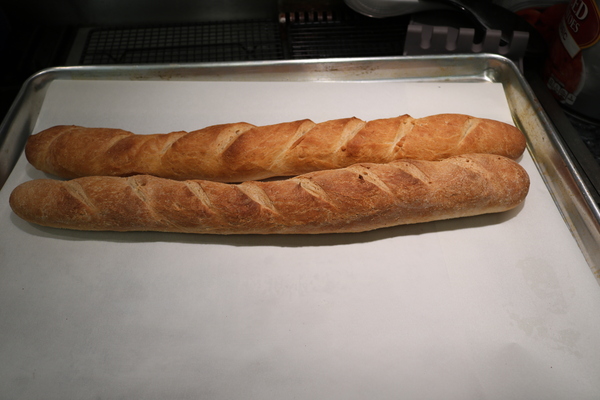
Can you tell which was which?
Most of the sources I've seen for using triticale say you can substitute it for up to about 25% of the flour in a recipe. Above that and the bread starts to have structural issue due to the types of gluten proteins in triticale. (They aren't as strong as the ones in wheat.)
There's quite a bit of taste difference between the two. The one with the triticale has a somewhat more complex flavor, I get notes of vanilla and a nuttiness to it.
I've also seen sources that suggest you can use it in place of rye flour in rye bread recipes. It suspect it wouldn't taste anything like rye bread, though.
We're going to send some of the bread in to the professor who gave us the grain, I suspect he won't have any trouble telling which is which.
I will be doing some more tests with triticale, possibly including some flatbreads/crackers. I'm also curious to see if you can make pasta with it.
BTW, the triticale baguette is the one in back.
Attachments:
You must be logged in to view attached files.February 19, 2020 at 6:22 pm #21476In reply to: What are you Cooking the week of February 16, 2020?
Supper tonight is bread and cheese, to use up one of the test loaves from yesterday (the Dutch oven one) and the baguettes I made today (some with triticale.) I'll post more on that in another thread later this evening after I've uploaded some photos.
February 19, 2020 at 5:46 pm #21475In reply to: Adventures in Steam
Thanks for posting, Eric, and welcome to MNK.
The Dutch oven pan was preheated at 450 for probably somewhere between 30 and 40 minutes. I didn't show the bottoms of any of the loaves, the one in the Dutch oven was the only one that was starting to show signs of scorching on the bottom, in part because the only way I can fit my Dutch oven pan in my oven is on the bottom shelf. Adding a pan to insulate it from the lower element a bit (yes, it is an electric oven) might help. I've got a couple of recipes that I have to double-pan to keep the bottoms from getting scorched before the top gets done.
All of the loaves suffered from being a little under-baked in the center, somewhat intentionally, because I pulled them all at the point where the top was showing a little dark brown. They probably needed another 5 minutes to be fully baked in the center, and that would have affected how dark they got, but it might also have made it harder to see the impact of the steam method. Lesson learned: Do some pre-tests before the production test. (My research methods prof would zing me for that, pre-testing your instrument was something he emphasized over and over.)
I will try the Dutch oven idea again, but for now my steam tube is working reasonably well. I did some baguettes with it today to test some triticale flour, I'll be doing more triticale tests over the next few weeks. (First lesson learned from triticale: It gets dark faster and can get scorched quickly.)
I did put the loaves back in the oven last night to get them a little more baked. The only complaint my wife got about the bread today was, "What, no butter?"
February 19, 2020 at 5:04 pm #21474In reply to: Adventures in Steam
Hi Mike, saw your link from the BBGA list (I was the original poster on that thread). Bravo on the systematic test!
I assume you have an electric oven? My gas oven vents out the front like crazy so I've never had any luck with any method but covered baking. My new oven will be electric, although it's expensive enough that I will probably be afraid to do any of these steaming methods, so will likely stick with covered baking, ha.
In my experience a cast iron dutch oven can produce a darker, crisper crust than your test loaf, if preheated at high temperatures (at least 450 F) long enough (at least 45 minutes). Keeping the bottom from burning gets tricky, although I've solved that by putting a sheet pan below the DO on the rack just below it -- seems to shield the DO from some of the heat from the oven floor.
Eric
February 19, 2020 at 10:47 am #21468In reply to: What are you Baking the week of February 16, 2020?
Today I'm doing a test with some triticale. I"m making the Pain de Campagne recipe (again!), but only two batches of it this time, one using the amount of whole wheat flour called for in Peter's recipe and the other using triticale flour instead of the whole wheat flour. I'll be making baguettes from both batches of dough.
February 19, 2020 at 10:43 am #21467In reply to: Adventures in Steam
I just finished editing the post, I think most of your questions are answered now. (BBPress only lets you add 4 photos at a time, so it was visible before I could add most of my comments.)
February 19, 2020 at 10:20 am #21455In reply to: Adventures in Steam
Steam Test Photos
Well, the steam test took about 12 hours, but I learned quite a lot, not all of it about steaming bread. 🙂
Here's a group photo of the 8 loaves I baked, followed by a shot of each one of them, with comments. The group shot shows them in order left to right, back to front.
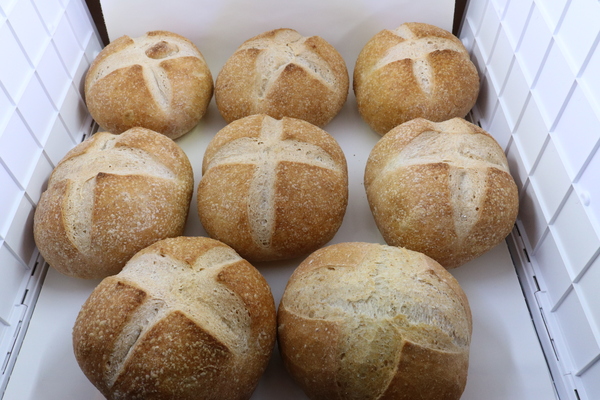
Each of the loaves is 12 ounces of Pain de Campagne from the Bread Baker's Apprentice. The boules were just under 4 inches in diameter after shaping and 5 to 5 1/2 inches in diameter after baking.
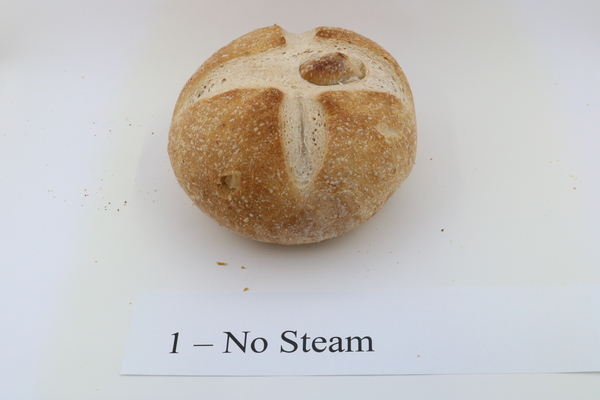
Here's the 'control', a loaf made with no steam. The surface is relatively smooth.
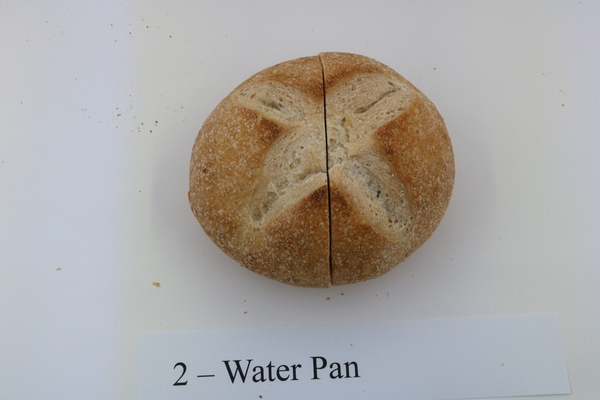
This test had a pan of water in the oven during the pre-heat cycle, removed at the 10 minute mark.
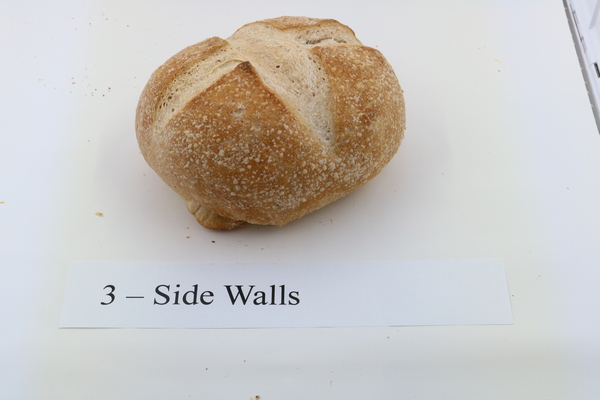
For this test I sprayed the side walls 3 times during the first 3 minutes of baking. This is the method I've been using for the past several years.
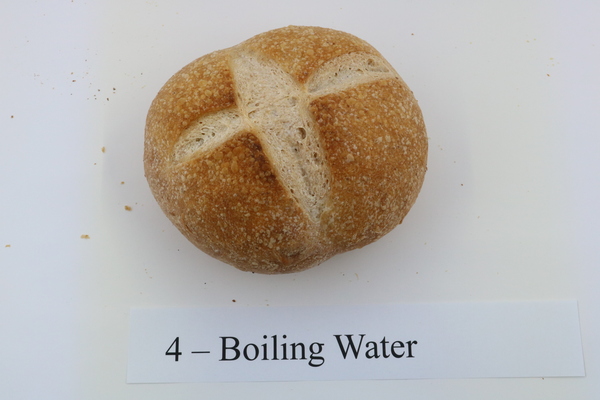
This test had a cast iron skillet in the oven during preheat, and I added a cup or so of boiling water when the loaf went in the oven. The pan came out at the 10 minute mark.
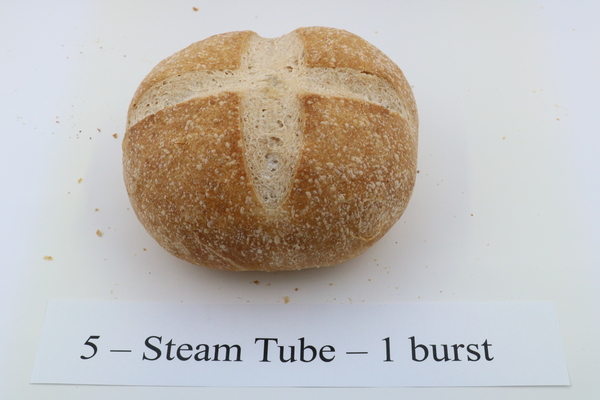
This is the first test with my steam tube setup, I put in 20 CCs of water.
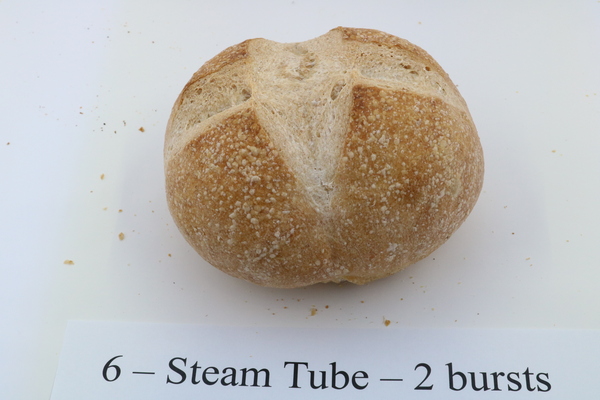
This is the second test with my steam tube, I put in a total of 40 CCs of water in two bursts about 2 minutes apart.
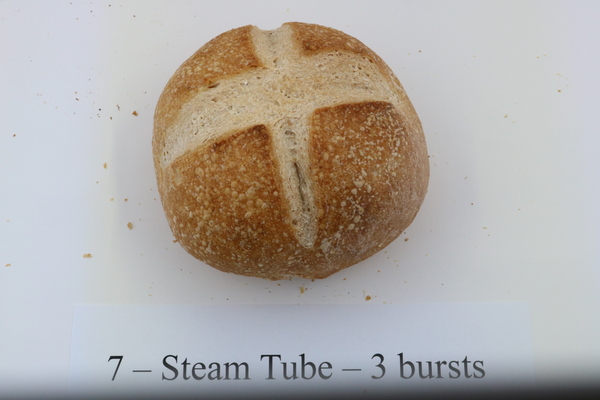
This is the third test with my steam tube, I put in a total of 60 CCs of water in three bursts about 2 minutes apart. All of the water had evaporated by the 10 minute mark.
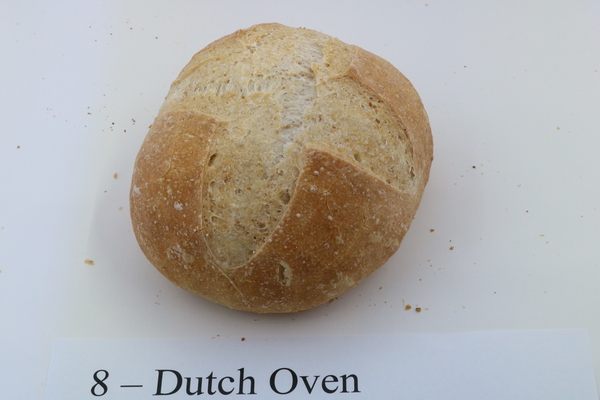
This test was done in a round Dutch Oven, with the lid on for the first 15 minutes.
What did I learn?
Looking at the 8 loaves, the ones I liked best were 3 (side walls), 4 (boiling water) and 7 (steam tube, 3 shots of steam.) I think the overall winner is the steam tube setup with 3 shots of steam, but the boiling water one is a surprisingly close second, I think that's the method I'd recommend most people use. Although a lot of the steam goes out the open oven door, apparently there's enough of it to do a decent job.
I find pouring boiling water from a tea kettle is far easier than other methods I've used, though I did see an interesting suggestion that you use a wine bottle. It accomplishes much the same thing, giving you more control over the process while keeping your hand away from the blast of steam.
The interior shots aren't all that interesting, there really wasn't a lot of difference between them. They were all a bit underdone, I should probably have done a pre-test to establish the total baking time for this size loaf.
I have to say I wasn't all that impressed with the dutch oven one. It probably got the most oven rise, but the surface wasn't nearly as dimpled as the others, it looked a lot like the 'no steam' loaf except for the way the oven rise pretty much filled in the cuts. A lot of people like this method, I may have to try it again.
I did discover a relatively easy and safe way to put the loaf in a Dutch Oven pan. I have a 'cookie spatula' that I got from King Arthur Flour a while back, though I don't think they sell it any more. It is a large offset spatula that is about 6 1/2 inches wide, so I just put it under the parchment the dough was shaped on and lowered it into my Dutch Oven without my hands getting even close to the hot pan.
Attachments:
You must be logged in to view attached files.February 18, 2020 at 6:19 pm #21445In reply to: Wholegrain Crispbread by Jan Hedh
Yesterday (Feb. 17), I put most of the that Kamut-Lemon Crispbread that was more like focaccia into the trash. Neither of us wanted to eat it, and there was a somewhat bitter aftertaste, which might have been the anise, but I'm wondering if it was the baker's ammonia. At any rate, I no longer have to look at that waste of good ingredients. I don't plan to try that recipe again.
February 18, 2020 at 5:22 pm #21444In reply to: What are you Baking the week of February 16, 2020?
According to the USDA database, 1 cup of packed brown sugar is 220 grams, 1 cup of unpacked brown sugar is 145 grams (65%), so your 1/4 cup of unpacked brown sugar was probably the equivalent of just under 8 packed teaspoons.
February 18, 2020 at 4:40 pm #21443In reply to: Adventures in Steam
Well, the set of pictures won't be quite complete, I ran out of space on the camera's memory card mid-way through test #6. I deleted some unneeded stuff (which I should have done last night) and was able to get the last few minutes of that bake, but I missed the shot at the turn. I think I cleared enough space for the final 2 tests, but I'll double check that before the next one goes in.
February 18, 2020 at 4:01 pm #21439In reply to: What are you Baking the week of February 16, 2020?
I still haven't done anything with the 8 pounds of triticale grain my wife got from the wheat breeder at UNL. I've been researching triticale, it has kind of a mediocre reputation for breads, something I think the researchers are working on, currently most of the triticale being grown is used for animal feed. You can use it like rye in a wheat/rye bread, I may try that using a recipe I'm familiar with. (Probably not one of the Ginsberg recipes quite yet.)
I might also try it in some pain de campagne, it is a lean dough but with a small amount of whole wheat flour added for taste and texture.
I've also been thinking I might try making a wheat/triticale cracker, the structural issues with triticale shouldn't impact a flat bread much. Crackers are something I've not yet mastered, though, so it could be a real learning experience for me.
-
AuthorSearch Results


