Search Results for ‘(“C’
-
AuthorSearch Results
-
April 25, 2020 at 7:01 pm #23233
In reply to: The yeast shortage
I've been experimenting with cutting back on yeast. For the 8x4 loaf I baked today, I used 1 3/4 tsp. yeast rather than 2 tsp.
On the Pumpkin-Ginger Braid that I baked yesterday (and it is delicious, particularly with a Greek Yogurt-Cream Cheese blend that Kroger sells), I cut back 1 Tbs. to 2 3/4 tsp. The rise and bread came out great.
In fairness, I also cut back the salt by 1/4 tsp in both breads. I have a hypothesis that recipe developers don't like to use 3/4 tsp. measurements where yeast is concerned.
-
This reply was modified 6 years ago by
BakerAunt.
April 25, 2020 at 6:50 pm #23230On Saturday, I also baked Barley-Wheat Bread, a recipe that appeared in the glossy King Arthur Baking Sheet (Summer 2009), p. 10. I remember discussing this recipe on the Baking Circle with Cindy (not Mrs. Cindy) who needed to use up some rolled barley. I reduced the salt by a quarter tsp. and added 2 Tbs. special dry milk. I replaced the 2 Tbs. of butter with 1 Tbs. olive oil. I reduced the yeast by one-quarter tsp. I let the Zo bread machine do the kneading. I had to add 1 Tbs. whole wheat flour and a half Tbs. of AP flour. Both risings went well, and the loaf baked in 40 minutes. It had a great rise, although it has a tiny bit of "spillover" in the center on both sides. The 8x4-inch loaf pan is almost a bit too small.
April 25, 2020 at 3:10 pm #23217Skeptic. I will look for the recipe; right now, I'm not sure where it is. (My recipe organization needs work.) When I find it, I can post it--if that's ok with Mike--since it no longer seems to be around. Or, if I can find the name, Rottiedogs might be able to find it in the Way Back machine and give you a link.
It may be that the recipe originally appeared in one of the email recipes that King Arthur used to send out regularly. I miss that time.
April 25, 2020 at 1:12 pm #23210There are two main differences between a puff pastry dough and a croissant dough.
Puff pastry does not use yeast, it relies on the water in the dough (and especially in the butter) to cause it to puff up.
And because it is using the butter in the water for that purpose, puff pastry generally uses more butter than croissant dough. A typical croissant dough will have the butter block weigh 25-30% of the detrempe (dough) block, for puff pastry the butter weight is usually 45-55% of the detrempe.
April 25, 2020 at 1:10 pm #23209In reply to: The yeast shortage
Yes, Whole Foods Amazon is for local delivery so you have to have a store reasonably close to you. Before Whole Foods was bought by Amazon, you could get local delivery through Insta Cart. I realize not not everyone has access to it but the point I was wanted to make is that fresh cake yeast can be found, at least in some areas. Also, there is yeast to be had out there somewhere, maybe (hopefully) it will start to show up on store shelves soon.
April 25, 2020 at 12:03 pm #23205I've locked the weekly baking thread so I can test new themes to see if they exhibit the lost posts problem, so I figured I'd start the new weekly baking thread a day early.
April 25, 2020 at 8:38 am #23192In reply to: What are You Cooking the Week of April 19, 2020?
I'm headed to the kitchen to make rice pudding for a late lunch. I know it sounds strange to have pudding as lunch, but it has milk (protein), rice (starch), 3 eggs (protein), raisins (fruit), white Splenda (non-caloric sweetener), and lots of cinnamon, which helps control blood sugar (so I've read). Sounds like a wholesome lunch to me.
April 25, 2020 at 8:03 am #23188In reply to: Coming Through the Rye
Thanks for the detailed report, Mike. I've occasionally let a sponge go too long, and that sourness is pronounced. I didn't realize that underproofing could cause a blowout and why it usually happens with loaves where I'm not sure if they have fully risen. I always have a slight blowout on that pumpkin-rye bread recipe from Ginsberg's blog, even though I slash it (which the recipe does not state).
I don't recall if Ginsberg mentions what kind of oven he uses. I'm still learning about my Wolf oven and the best rack position at which to bake various items. I have learned to check most recipes five minutes early, and with Bundt pans, I've been baking at 325F rather than the usual given temperature of 350F.
Maybe the bread would make good croutons?
April 24, 2020 at 9:37 pm #23166In reply to: Coming Through the Rye
Report on Kassel Rye (Ginsberg, pps 332-335):
I was tempted to call 'no joy' on this recipe and not give much of a report; Ginsberg says it is technically challenging, and that certainly appeared to be the case for me, but I've never been one to gloss over my less successful bakes.
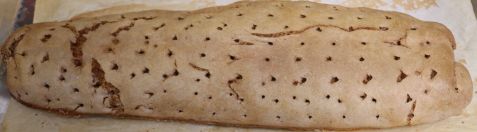
To start with, I'm not sure my new starter was fully ready for this recipe, though it looks and smells like the last one did. I'll give it a few more feedings before I try it again.
The recipe uses a 67% hydration sponge, so it should have been similar to the final dough, which is at 65% hydration. But it seemed quite dry, and it just sort of sat there overnight when it should have doubled in size. So, I added some more water and another teaspoon of starter and gave it another night. It was plenty active this time, maybe too active, I'll explain further later on.
Of course I subtracted the extra water from the final dough. It came together fairly easily, and the final dough weight was pretty much spot on. In retrospect, the dough might have been a little too slack, though.
The bulk rise instructions didn't exactly specify how much it should rise, though it did increase by about 50%. The final proof was done in a basket lined with my couche.
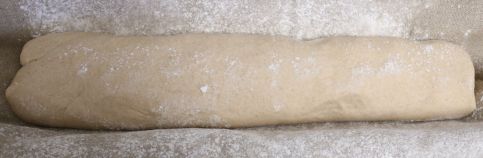
Here's what it looked like after proofing.
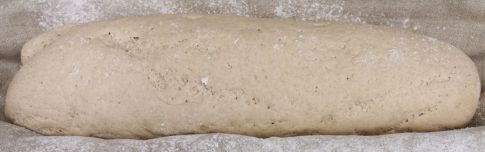
When I turned the proofed dough out onto the parchment, it flattened out a bit. Docking the dough didn't seem to deflate it much.
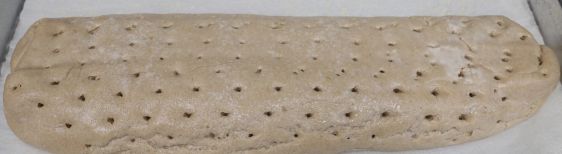
It bakes at a high temperature with steam for the first 10 minutes, then the temperature is lowered. After another 30 minutes or so the top is sprayed with water and it is baked another 5-10 minutes; spraying it with water is what is supposed to bring out a shiny finish that should have a red tint to it.
My steam setup wasn't working quite right, later I figured out that the tubing had gotten pinched a bit. I wound up squirting about 50 cc's of water by hand into the steam pan, but that means opening the door, letting at least some of the steam escape. I don't know how much impact that had.
After the top was sprayed with water, it still wasn't getting very dark, so I let it bake a bit longer. It was already pretty solid and the internal temperature was already 208, I think it may have already been overbaked by then.
Ginsberg says the recipe is fully risen when it goes into the oven, and I can confirm that was the case, as there was little or no oven spring. It did blow out a bit on one side, so it seems likely that the final proof needed more time, underproofed dough often results in a blowout as the water in the dough turns to steam.
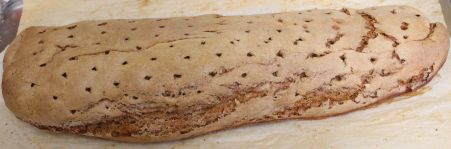
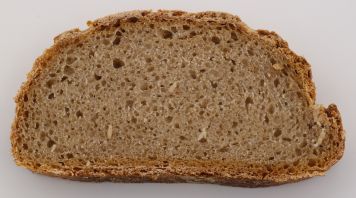
The cross section was no more than 2 1/2 by 4 1/2 at the widest point, the piece below is 2 x 4 inches. I was expecting it to be more like 3 x 5.
I didn't weigh the loaf before cutting into it.
The crust is very thick and REALLY dense and hard to cut through. The inner crumb is fairly tight. It smelled very good, but the taste is well beyond what I'd call 'mild sour', and there's a slight bitter aftertaste. I'm tempted to attribute the sourness mostly to the sponge having sat for a total of 40 hours with twice as much inoculant and the bitter aftertaste to being overbaked.
I did double-pan it so the bottom doesn't appear burnt.
I'm OK with the bread, I think it is a bit too sour for my wife. The crust is too stiff to be used as a sandwich bread. The crust may be too stiff to toast.
So, what have I learned for the next time?
1. My starter may not be ready for prime time yet.
2. Don't give the sponge 2 days to rise.
3. Make sure it is fully proofed before prepping it for the oven.
4. Lower the oven temperature. (This is something I've noted in other recipes, and so have others baking recipes out of this book.)Attachments:
You must be logged in to view attached files.April 24, 2020 at 4:53 pm #23155In reply to: What are You Baking the Week of April 19, 2020?
On Friday, I baked Ginger Pumpkin Bread, a yeasted, six-braid bread from the KAF site. I’ve baked it once before and substituted in 2 cups of white whole wheat flour. This time I increased that to 2 ½ cups. I used 1 ½ cups bread flour and ½ cup of high-gluten flour to stretch my bread flour. I added 1/3 cup special dry milk and ¼ cup flax meal. I reduced the salt from 1 ½ to 1 ¼ tsp. I increased the diced ginger to ½ cup and used golden raisins. I replaced the butter with 4 Tbs. canola oil. I use my own spice mixture of 1 ½ tsp. cinnamon, ½ tsp. ginger, and ½ tsp. freshly ground nutmeg. The recipe calls for 1 Tbs. of special gold yeast. I reduced that to 2 ¾ tsp. I warmed the pumpkin puree with the sugar, then proofed the yeast. I mixed in the eggs, then put that into the Zo bread machine bucket, then the flour. I held back the raisins and the minced ginger until near the end of the kneading cycle when the machine beeps. I let it rise in an oiled 4-qt. bucket with snap lid.
I have the KAF baking mat with the braiding instructions. I managed to do the braid on my second try. It helps to write the numbers and put them at the top. The second rise was 55 minutes. I brushed with an egg (did not add water, as I want to use the rest of the egg wash for another recipe). I baked it on the third rack up in my oven. I probably should have used the second rack up, which is my usual rack for loaf pan breads, because it was not done in 30 minutes. I needed to bake it almost 15 minutes longer to get it to 193F. I tented it with foil after 30 minutes because it was starting to overbrown. It’s cooling on a rack now. It’s a lovely looking loaf. I look forward to cutting it tomorrow.
-
This reply was modified 6 years ago by
April 24, 2020 at 10:24 am #23146In reply to: What are You Cooking the Week of April 19, 2020?
You cut the stems off, cut the tips off (they're sharp!) and peel off some of the outer leaves. Then you put them in a container with a little lemon juice and water and steam them. If you do it in a pan, it takes 20-30 minutes depending on their size. My wife does them in the microwave in about 10 minutes, you can also do them in an instant pot or pressure cooker.
When you can pull off a leaf easily, they're done.
To eat the outer leaves, you peel them off, dip them in a sauce of your choosing (I like sour cream, my wife likes bleu cheese dressing) and scrape off the inner soft part with your teeth. As you get further in, you can nibble on the edge of the leaf a bit, but if it won't easily come off, it is too fibrous to be edible. If you're fortunate enough to find fresh baby artichokes (about the size of a plum), there's a lot more of it that is edible.
When you get to the center, you scrape out the fuzzy 'choke' with a spoon to get to the heart, which is the best part.
Get a big bowl for the scraps you can't eat. I'm told you can compost them, but I've never done it.
Artichoke have an amplification effect on your taste buds, they enhance the taste of everything else you eat.
April 24, 2020 at 10:03 am #23144In reply to: Playing with bread upload pics
If you're on a PC, I strongly recommend using Irfanview. It is free for non-commercial use, and it gives you a lot of tools to manipulate images but it is very easy to use.
I take most of my photos at high resolution (6000 x 4000) and use Irfanview to reduce them to 600 x 400 before uploading them. Sometimes I'll crop out stuff on the sides that isn't needed, like the edge of the pan.
It has a batch mode for processing large groups of photos, but I usually do one or two at a time, so I don't use that mode a lot. You can manipulate all the way down to the pixel level.
I have something called a ShotBox, which is a portable small photo studio / light box with several photo backgrounds (a Christmas present from my son, who was one of the kickstarter participants for it), but I also went to the craft store and bought a 20x30 sheet of foam board that I use as a background for larger things.
April 23, 2020 at 11:20 am #23099In reply to: What are You Baking the Week of April 19, 2020?
The starter recipe I used avoided the "throw away" or discard by refrigerating the starter, then directing to let it come to room temperature (bubble), stir, take out what is needed, then feed. The issue with these directions is that unless the starter is being fed frequently, it won't have enough oomph without some yeast. I find it better, if I want to bake bread with it (even with a bit of yeast), to time the bread making so that it is the day after I've done my sourdough crackers and fed the starter.
The recipes that came with the starter specified an overnight sponge that mixed some of the starter with flour and water.
So, until I started reading up on sourdough, I'd never heard of "discard."
April 23, 2020 at 11:06 am #23098In reply to: What are You Baking the Week of April 19, 2020?
I've always found it odd that home sourdough instructions nearly always recommend throwing away half of your starter at every feeding or using it for something other than bread, commercial bakeries do not do that (because they couldn't afford to!) They feed their starters a few hours before they plan to start another batch of dough, then take the half they would have thrown away and use it to inoculate a day's worth of dough, and the starter is at its most active point by then, too.
Maybe it's just because most home bakers don't bake bread every day, like a bakery does?
April 23, 2020 at 10:56 am #23097In reply to: Cake question for swirth
I think that recipe is in the recipes section here under two or three different names, I've heard it called crazy cake, cake-in-the-pan, no-egg cake, etc. The recipe supposedly was developed during world war II when eggs were in short supply.
One caution I will make on this recipe is don't top it with aluminum foil to store it, the low pH causes it to eat right through the foil. (It may not be all that great on metal pans, too, but we usually do it in a glass 8x8 pan.)
-
This reply was modified 6 years ago by
-
AuthorSearch Results


