Mike Nolan

Forum Replies Created
-
AuthorPosts
-
I can't help but think of the Bullwinkle version of that poem, in which 'smithy' becomes 'jonesy'.
I've got a sliced ham marinating in pineapple juice and I'll bake it for supper, it should go very well with the rye bread I made on Friday.
I'm also making a batch of potato salad, because it's Memorial Day Weekend.
Did you maybe misread '29' as '24'? I know I did something like that two weeks ago.
I recently ordered some sheets online, and the initial estimate of delivery is sometime between early June and the middle of July!
Delivery services are seeing unprecedented demand for this time of year, and are prioritizing items that are deemed more critical, like medical supplies. I'm guessing King Arthur Flour isn't on the high priority client list.
Amazon tried to lower its usage of Fedex, but ran into capacity issues on its own delivery system, so they've gone back to having some packages carried by FedEx.
We planted two American Chestnut trees in the front yard last year, they're doing fairly well this year. This is the 2nd time we've tried this, the first ones didn't survive the first summer, I think they didn't get enough water.
One of them is almost taller than me at this point, the other one was a little shorter to start with but may be taller than me by the end of the season, because annual growth for young chestnut trees can be 2-3 feet.
These trees will eventually take the place of two ash trees that will probably be lost to the emerald ash borer, which has been detected in Lincoln.
We had steak, mushrooms, baked potato and broccoli.
It's been almost two weeks since I made the chocolate chip challah, and the half of it that I didn't freeze is still moist and hasn't gone moldy.
Must be due to the sweetness.
Report on Dakota Norwegian Rye (Ginsberg pps 83-86)
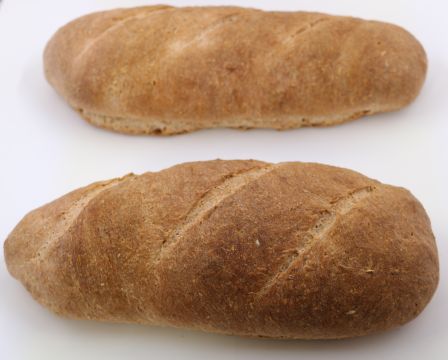
Although it uses five different flours (whole wheat, bread flour, fine rye meal, rye chops and medium rye flour), this isn't really a complicated recipe.
I chose to make two loaves about 475 grams each, about 10 x 4.5 x 2.5 inches, instead of one larger football-shaped loaf. This way the slices are closer to deli rye slices.
The dough came together quickly and rose well, though in retrospect I think I should have let the final rise run a bit longer, there are very minor blowouts on one side of both loaves towards the bottom. You may be able to see that better on a single slice. I baked it at a slightly lower temperature than what Ginberg's recipe calls for, I've found that many of his recipes seem to work better that way, I think my oven is just a bit hotter than his.
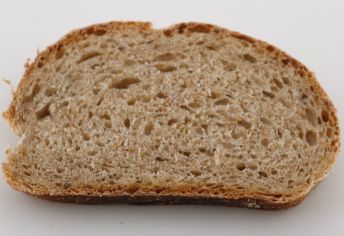
It passes the toast test superbly, and it made pretty good Reubens for lunch today. If I was after a soft rye with a good rye flavor, I'd certainly include this in the possible choices.
Given that it is only 29% rye, I was expecting a very mild flavor, but it is a bit stronger than that. The dark brown sugar in it gives it a hint of molasses, and the caraway adds some bitterness. I can also taste the sourness of the starter, though it is quite mild.
Attachments:
You must be logged in to view attached files.Welcome back!
There appear to be a number of commercial bakers who use SAF Gold exclusively, based on the comments in the BBGA forum. They echo what BakerAunt said about needing to use less than with SAF Red.
I saw SAF Red at Hy Vee the other day, Sams had the Fleischmann's IDY I've been using for the past 15 years, too. I haven't been to Costco recently, they were carrying Red Star back in January.
SAF Gold is still a little harder to find, but there was only one place in Linoln that I know carried it last year.
Today's baguettes just came out of the oven, I think I left them in a couple minutes too long, they got a bit scorched on the bottom. I was using a perforated baguette pan, something I bought some years ago but had only used once before today. It makes baguettes that are about 16 inches long, so I made them with 220 grams of dough per baguette. If I use this pan again, I'll probably increase them to about 240-250 grams per baguette.
I also made two epis, they came out pretty good on the bottom, but they were on an air-bake pan and went in a minute or two after the baguettes did.
I also made some rye bread out of the Ginsberg book, I'll post a report about that later tonight after they've cooled.
I'm prepping to make baguettes tomorrow, along with the Dakota Norwegian Rye from Ginsberg.
My friend who has been thinking of opening a food truck for barbecue has pushed back his plans to at least 2022. He's on the low end of the seniority list at his job (a railroad mechanic) and they're said to be considering cutting back because of reduced rail traffic.
I saw butter at $2.68 per pound today. The fancy butters (Pflugra, Kerrygold) seemed to be at their usual price.
I bought a five pound bag of rye chops a while back, I don't remember who from. It was a bit cheaper than whole rye berries. I thought I could grind them up to make pumpernickel flour if I ran out of it.
They're close to the size of my cracked wheat, which I'm OK with.
My older son has been making breads out of the updated AB5 book, he made a rye bread the other day and was pretty happy with it.
My wife had to make the elastic straps a little longer than the pattern called for so that my ears didn't get bent out of shape. She said I had a big head, though she didn't use the word 'big'. 🙂
I saw an article about how to avoid fogging your glasses while wearing a mask, one suggestion was to use a bendy straw that come down to your chin to breathe out. Seems to me that sort of defeats the purpose of the mask, though.
-
AuthorPosts
