Here's my first crack at a multi-stage formula with costing, using a buns recipe posted on the BBGA forum recently.
You can do things like tinker with the overall hydration level, the percentage of the total flour in the preferment, the hydration level of the preferment, the desired dough quantity and the yield.
If you're interested in trying this recipe (I haven't tried it yet, but will tomorrow), the preferment should sit for 12 hours. Bulk proof for an hour, final proof for 90 minutes and bake for 20 minutes at 380, with steam if possible. I think the baking time might be a bit long, but as I noted, I haven't tried this recipe yet.
Attachments:
You must be
logged in to view attached files.
Tonight we had burgers on the grill, tomorrow I'm doing ribs on the grill though I may bring them inside for the wrap stage, especially if the air is starting to smell like gunpowder again. (It's that way now but it didn't really get noticeable until after the burgers were off the grill.)
The cinnamon pretzel (sticks) are a little better today, but still not memorable. If they keep improving, I might actually try this recipe again, hoping to get a less crumbly dough that I can actually shape as pretzels. Maybe more egg or other moisture?
I'm doing a double batch of peanut butter cookies tonight, so I can take a tray of them to the block party following our 4th of July block parade.
I think we're having melon and salami tonight, and probably salad. (We still have LOTS of lettuce from the Aerogarden and I'll need to pick it again later this week.)
When our younger son moved to California, it totally changed what we were eating, both in terms of what we ate and how much we fixed at a time. Some things we make more often, some things we do less often. We definitely do take-out a lot more often these days, too.
I'm afraid if I was alone I might eat macaroni and cheese every other day. Even something like tacos is a lot of work just for two people getting all the toppings ready, browning the meat, then putting everything away again. And a Texas Chocolate Sheet Cake would last a long time. (Fortunately, it freezes well.)
Smaller portions of foods are a lot more expensive per serving, too.
I love to garden, but not this year! I've never seen anything like the current weather. According to my weather station, we got 2.33 inches of rain this week. I haven't yet added up the month's total, but I suspect it is around 6-8 inches. I'm usually just hoping for an inch a week to maintain my plants. Some days we get 8-10 storms a day, drizzles or downpours, no sun. Days with no sun, and for the last couple of weeks we've had haze and smoke from the wildfires in Canada. Most of my plants have survived and are growing lots of greenery, but they're not producing. My cherry tomato is about 4 ft tall, and has a few small green tomatoes. The herbs look great, crowding each other out of their planters. In my in-ground garden, inside the electric fence I have broccoli, cauliflower, cabbage, and about 2 dozen bell peppers plus 1 jalapeno, and cukes and zukes and summer squash. Surrounding the fence I have 6 Celebrity and 6 Amish Paste tomatoes, along with 2 hills (4 seeds planted in each, some rotted from too much water and cool temps) each of Delicata, spaghetti, butternut, and buttercup winter squashes. In planters on the deck I grow lots of different varieties of lettuce, spinach, beets, radishes, scallions, green and yellow beans, a cherry tomato and 2 bell peppers, plus about a dozen herbs. We do have a good crop of raspberries and blackberries coming along, but lost most of the blueberry blossoms and all of the apple blossoms when we got a hard freeze of 24* in mid-May. I guess we won't starve if the sun shows up soon, but I may be shopping a lot at the farmers' markets this summer. I hope the rest of you gardeners are getting lots of produce!
I baked Len's Rye/Whole Wheat/Semolina buns (as 10 buns) on Friday for us to have at dinner with salmon patties.
There may be alternatives to vegan butter, which I've always found disappointing. (We have some vegetarian/vegan friends, they're always looking for a better vegan butter.)
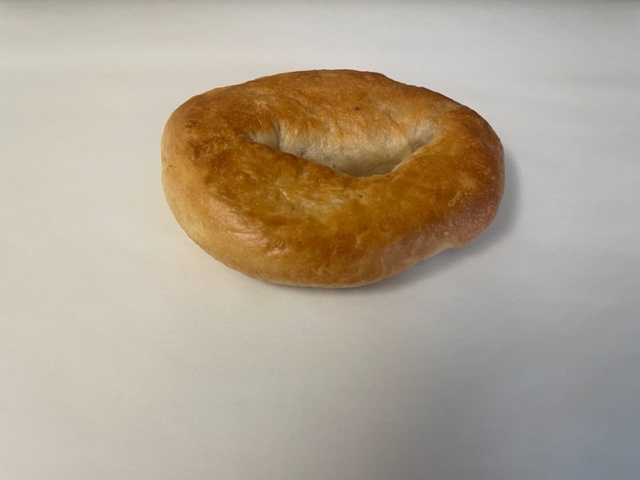
I made bagels today, using Hamelman's recipe with a slight modification of his procedure, I left out the bulk rise, shaped them right after kneading and refrigerated them overnight. He also has you put the bagels in an ice water bath after boiling them, that led to an increased baking time. But they came out pretty good, the last batch was badly overproofed and they were wrinkled. These were a little flatter than I was expecting, but the interiors were good. They've got a good shine to them and a satisfying snap in the crust.
Diane said she liked this recipe better than the one I've been using (Reinhart), other than procedure the major difference is Hamelman's uses diastatic malt powder instead of malt syrup.
Attachments:
You must be
logged in to view attached files.
I am not vegan, but I have a brother-in-law and two nephews who are, so I have been exploring a few items that I can bake that do not use eggs or dairy, which are both a big part of my baking. My problem with most vegan ingredients is the long list of artificial ingredients that goes into trying to simulate the original non-vegan ingredient.
With a sweet roll recipe that I found on line at Love and Lemons, I have been able to tweak the original recipe it to make it healthier by including whole grains, replacing the coconut oil with avocado oil, adding some flax meal, and reducing the glaze by half. I substituted slightly more than half white whole wheat flour the first two times I baked the recipe. This time, I used whole wheat flour instead of white whole wheat, and I do not detect any difference in taste and texture. In the future I will use the whole wheat, which is less expensive and has a higher nutritional value. I might even increase the amount that I substitute next time.
The almond milk I made is less processed than what I could buy in the store and does not include the preservatives, but the calcium is dramatically less than what is in a cup of milk. Where a cup of milk has 250 mg (where I live!), a cup of my homemade almond milk has 60 mg, so only about 25%.
I am not sure that I can do more to increase the nutritional value of this recipe.
I still have a cup of homemade almond milk to use (my dairy allergic friend tells me it only lasts about 5 days and does not freeze well). I have an oil-based scone recipe, but it calls for an egg. I may try replacing it with flax meal and water, and I would adjust the baking powder and baking soda, as I would not be using buttermilk.
I've got several zucchini that'll be big enough to pick soon, currently they're about 5 inches long and an inch in diameter. I'm looking at zucchini bread recipes.
I need to keep a log of how many zucchini I pick and how big they are as part of the urban soil improvement study. (I'm not planning to let any grow too big, though.)
There are a few tomatoes on the 4th of July plants, but they're probably 2-3 weeks away from being ripe. But tomato season is coming, other varieties should start producing by the end of July.
I've been playing around with a new Excel spreadsheet format for recipes, here's where it stands at the moment.
The recipe is entered using baker's percentages, then you enter the total dough weight you want to produce and the number of pieces it makes. What's new in this version is ingredient cost information. Package size is for things like cookies, where you might package them by the dozen. The fields you can adjust are all in yellow.
Here's an example using Hamelman's bagel recipe from his book, sized for 9 bagels a little over 3 ounces each before baking. (But if you make larger bagels or more per batch, you only have to change one or two fields to update the whole spreadsheet.)
It does not include any toppings, the cost of running the oven, or any labor. (Toppings could be added, but I usually make two or three different types of bagels, so I'd need separate costing formulas for each type, it looks like putting cheese on top adds as much as 15 cents per bagel, poppy seeds are probably less.)
The cost of the ingredients in the poaching liquid isn't included, either. (I usually put a tablespoon or so of honey in the poaching liquid these days, having been convinced by some BBGA members not to use baking soda.)
This is a simple one-stage formula, I'm planning to expand this to handle multi-stage formulas (for example, with a pre-ferment or starter.) Another possible area for expansion is to include nutritional information, which requires having an ingredients database.
Attachments:
You must be
logged in to view attached files.
Will made a delicious meatloaf on Saturday which we ate for two days and then sandwiches for two more with his sourdough bread - we hadn't had any since February. We had assorted vegetables from the farmer's market including sweet corn which I haven't had since we moved here - I was spoiled by access to really good corn, so I avoid fresh corn at the supermarket.
Tonight, I baked salmon which we had with tomatoes (farmers market), mozzarella, olive oil, balsamic and a mix of fresh oregano and thyme from our garden - we don't have fresh basil which is why I didn't call it a Caprese.
I just bought another 50 pound bag of semolina, so I should be good for about 6 months. (We go through a lot of semolina bread in the summer, and a fair amount of homemade pasta in cooler weather.)
Each batch of semolina bread that I make takes 20 ounces of semolina (to 12 ounces of AP/bread flour.)
I also bought a 5 gallon food-safe bucket with a twist on lid to store most of it.
I only had a little more than 1/2 cup of semolina flour left and dough improver (not yet open) so I looked for a pizza recipe that only used 1/2 cup of semolina flour. The recipe only made one crust but it looked thick so I divided the dough in half. I ended up with a pizza cracker instead of a pie. Oh well.
I saw a story today--sorry, do not recall source (probably New York Times, Washington Post, or NPR)--that floods have also devastated wheat crops in China.


