Mike Nolan

Forum Replies Created
-
AuthorPosts
-
The usual explanation books give for cloudy stock is that you let it get to a full boil rather than a very mild simmer--just an occasional bubble or two. This emulsifies some fat into the stock, causing cloudiness. I generally run it through my chinois, which is not as fine a screen as cheesecloth would be.
Freezing it and thawing it also seems to help reduce cloudiness, though probably not as much as the other two methods.
If I"m making potato soup, it doesn't matter whether its cloudy or not, the soup isn't clear. For chicken soup, it depends on whether or not I add noodles or dumplings, both tend to cloud up the stock. It seemed to me that the onion soup I made a week ago got a little clearer after I added in the onions and the sherry, not sure why.
Next time I make a big batch of chicken stock I'll have to try both methods and see how they compare.
I don't know why this only seems to happen to you, but I un-spammed it.
Nice looking pizza! I wish I had space for a wood-fired oven in the back yard, wood-fired breads are so different from ones made in a regular oven, but I don't know how muh we'd use it, we hardly used the outdoor gas grill last summer.
We had steak, mushrooms and baked potato for supper tonight.
I haven't actually tried cooking with tomatillos, they're pretty tart when raw but are supposed to get sweeter when they're well-cooked.
That's a lot of pizza, they look great, too!
Epis are fun to make and eat, and in some ways easier than baguettes, my baguette slashes need work, I'm not sure if it is a dough issue, a tool issue or a technique issue. Maybe I'll get a chance to take a baguette class some day. (I was scheduled to take one the weekend ahead of my pastry course at SFBI but it was cancelled, probably insufficient registrations.)
With epis you need to cut about 3/4 of the way through, so they are still connected but not by a lot of dough. A challenge with epis is they have to be far enough apart on the baking sheet that the 'grains' on adjacent loaves don't touch each other.
When I took my pastry class at SFBI, the production staff invited me to come roll out some baguettes during a lunch break, I wasn't as fast as they were but I think mine looked pretty close to theirs. Their pre-shape technique was different than mine. I flatten the dough into an oval, fold the bottom up to the middle, fold the top down to the middle then fold the bottom up to the top and seal. They flatten, then fold the bottom up to the top 3 times, then seal.
Getting a baguette that is pretty uniform in diameter down the length is the real challenge, you don't want one that looks like a snake that swallowed several mice.
The only loaf that came home intact was the Auvergnat, because nobody wanted to cut into the lion. Just small pieces of some of them left, others were gone.
My wife said she had people coming in her office all day to get a little more bread. She was having fun as they sampled different loaves asking them if they noticed a difference in flavor, and when they said they did, then they were surprised to find out they all came from the same dough. Steve, the wheat breeder, was one of the few who knew shape impacts flavor.
Triticale pasta is next to try, probably Friday evening so that if it doesn't work, we have time for plan B.
My wife says the triticale breads are going over very well, several people have come back for more pieces. (She did take in some butter this time.)
The professor who gave us the triticale liked it, too, and interestingly enough he'd not had anything made with triticale before.
I've never been a fan of Earl Grey tea, but bergamot oil is available separately.
I had a green tea custard at Nobu in NYC when it first opened, it was part of a flight of 3 custards on the dessert menu. It was interesting but not something I'd ever make.
I was happier with one of the epis than the other, and the baguette wouldn't have done well as a competition bread, the slashes were too uneven and there wasn't a clean 'ear' on any of them. The fendu came out very nice. Two of the shapes were new for me and were definitely learning experiences, but shaping bread is something I enjoy doing, and it still amazes me how much shape influences taste.
A few years ago I got into braiding breads, and I braided just about everything for several months, until my wife started complaining. (Braided breads tend to have shapes that don't make good sandwiches for things like sliced meats.)
I saw a suggestion in Marcy Goldman's book A Treasury of Jewish Holiday Baking to make a braided challah but put it in a loaf pan, so you get a nice square bottom but the braided top. I may try that.
A friend of ours is downsizing and brought a bunch of stuff over for my wife's annual Memorial Day garage sale. We got to talking about bread and she's never had challah, much less used it for French toast, so there will probably be challah on the schedule soon.
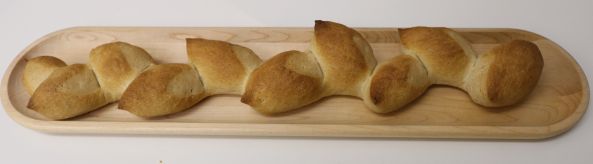
Epis are one of our favorite bread shapes, there's a lot of crust on each 'grain', so it is really crunchy. And you can just tear one off, no bread knife needed. It makes a great presentation bread at the table, we have a bread board that it fits on very nicely:
Attachments:
You must be logged in to view attached files.Pictures from today's bread shaping with triticale dough.
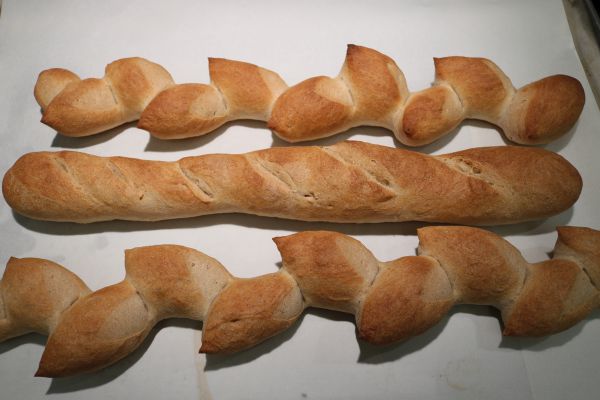
Here are two epis de bles and a baguette:
Here's a boule. (Not much different than the ones from two weeks ago in appearance).
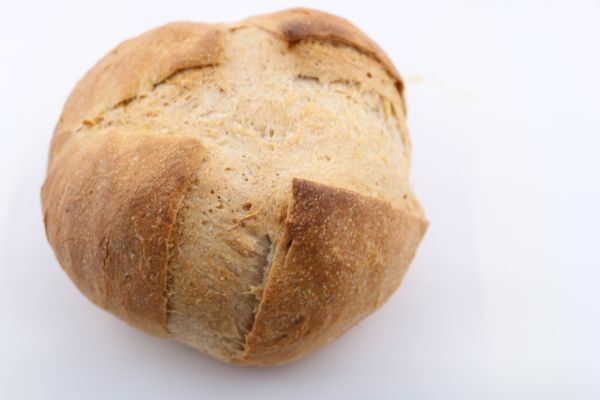
Here's a fendu, I think this one came out fairly nice.
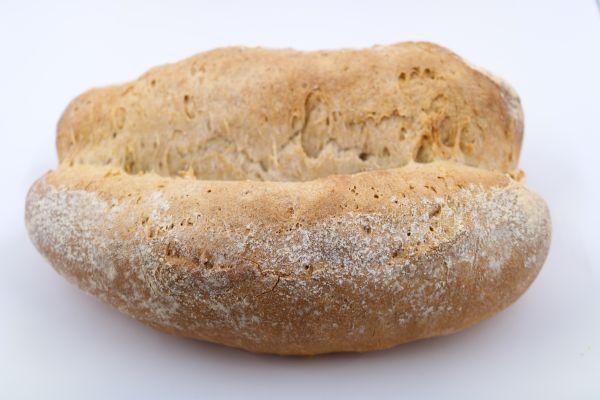
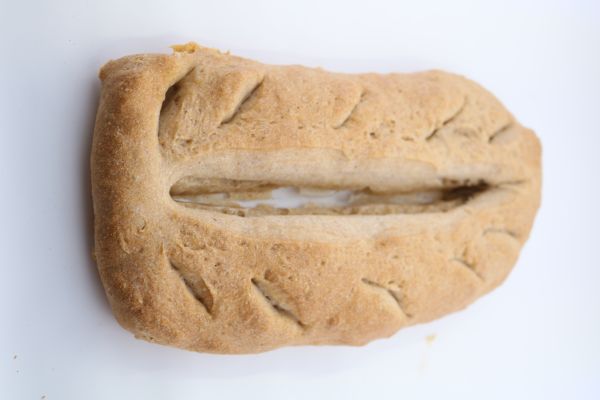
Here's the fougasse, the cuts on the sides are supposed to go all the way through like the one down the middle did. This increase the amount of crust, which I think is largely how shape impacts flavor.
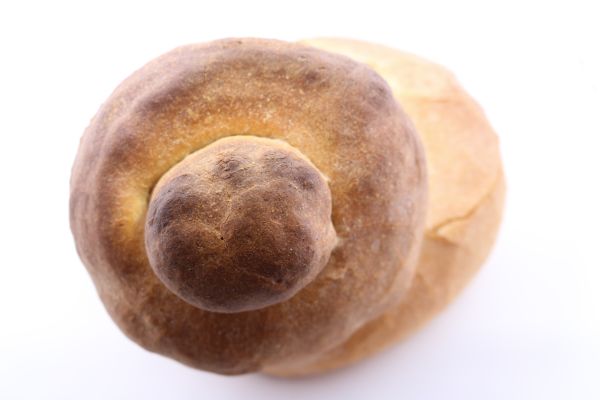
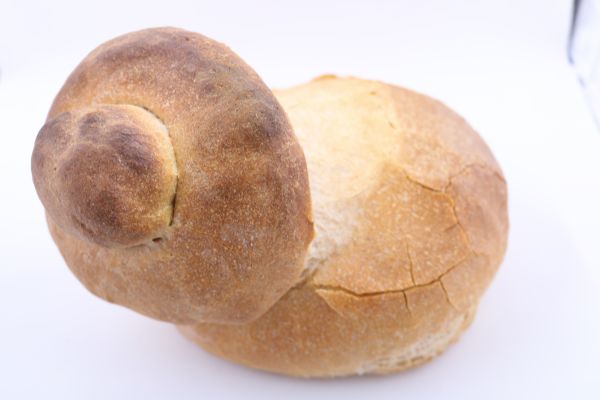
And here's the auvergnat, from two angles:
Attachments:
You must be logged in to view attached files.Two of my shapes didn't come out as well as I would have liked, the auvergnat fell over and the fougasse was sticking to the parchment and didn't get spread out as much as it should have after making the cuts.
I've tried searching for pictures of an auvergnat loaf, the the only ones I can find also appear to have fallen over, so maybe that's not unusual. I remember having problems at first getting a two-layer celebration challah to not fall off to one side, I'll definitely have to try this shape again. My wife likes the way it came out, she thinks it looks somewhat like a lion. (She collects lions, that's her sorority's mascot.)
Next time I may try shaping the fougasse on the work table and transferring it to the pan after stretching it, or perhaps putting it directly on the sheet pan or put some corn meal on the parchment first so the dough doesn't stick down so much. Live and learn.
I'm still taking pictures, I should have them posted later tonight or in the morning.
The 20% triticale dough was very tasty, we ate one of the epis with our onion soup for supper. Most of the bread will be going in to my wife's office in the morning, this time she's going to take some butter and a knife to cut it, especially the bigger loaves.
I'm making 6 pounds of triticale dough today, more or less following Reinhart's Pain de Campagne recipe, except that I swapped triticale for the whole wheat flour and raised it to 20% of the flour weight.
I'll be making 2 epis, a baguette, a boule, a fendu, an auvergnat and a fougasse.
The carrot cake I made last night didn't have any vanilla in the cake batter, with 4 spices it just isn't needed. There was a little in the cream cheese frosting.
The pieces of cake I sent in to the office were well-received, and nobody complained about the softer texture from using carrot pulp rather than shredded carrot, and some asked when I was going to make it again.
One person who had her wisdom teeth extracted on Friday and is still on a soft diet was able to eat a piece of carrot cake because it doesn't have the chewy bits of carrot in it. She was delighted to have something tasty to eat other than just things like mashed potatoes.
-
AuthorPosts
