Mike Nolan

Forum Replies Created
-
AuthorPosts
-
Happy birthday, Sara, I hope things are going better for you than they have over the last several years.
And let Cass know that we always appreciate his contributions here as well.
It's 53 and raining here, so I got some vegetable beef soup out of the freezer for supper tonight.
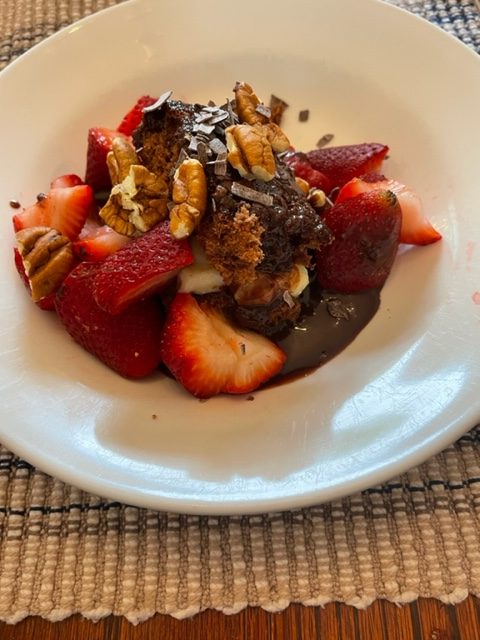
We had a lavosh pizza tonight, and some more of the genoise with strawberries, bananas, pastry cream and ganache.
I've seen suggestions to start a pizza on a pre-heated steel surface then move it to a different rack after the bottom has set.
In a traditional pizza oven, the pizza often gets moved around several times.
We put some slices under the broiler to dry them out a bit more, then melted some sharp cheddar cheese and poured it on. It was quite good as an appetizer, then we had salads.
I threw the rest of the loaf back in the oven at 350. I'll check it in a while, I think it needs at least another 45 minutes.
The bread is tasty enough that I'll make it another time before I write it up for the Rye Project thread, I'm calling this loaf an operator error issue.
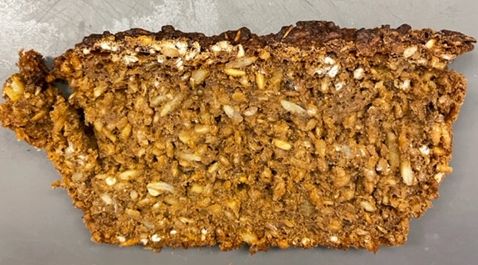
Here's a picture of the outermost slice, I'd say the flax seeds didn't break up much.
The bread is rather gummy, though the internal temp was well over 200.
It may need to cure for another day.
Attachments:
You must be logged in to view attached files.Croissants are often started at 500 degrees, I think a large reason for that is to keep butter from leaking out.
One of these days I'm going to try a pizza at 500 with the convection cycle on. Modernist Pizza apparently suggests that if you don't have a baking steel. I'm looking at getting a new outdoor gas grill this season, the one I've had for 26 years is wearing out. I need to make sure it is big enough to hold my Bakerstone pizza oven with the lid closed, it doesn't quite fit with the lid closed in the current one.
I'm sure the flax seeds softened a bit in the scald/soaker, but may have hardened back up during baking. How much flax seeds break up as you're chewing the bread is something I've wondered about.
We're going to have some of the Danish rye bread with sharp cheddar cheese for supper, plus a salad.
FWIW, DVDLEE's biscuits recipe uses 450 degrees. Bisquick biscuits also use 450, though there's no butter in them, and 425 for their shortcake. Most sources recommend you use a lower setting if you have a convection oven, usually 25 degrees lower.
I'm not all that artistic, either, even frosting a cake is a challenge for me, decorating it is beyond my abilities.
Some of the fast food chains sell desserts in a mason jar, I've always wondered if they're ones that can be reused for canning. I can buy pint jars for about $1 each, presumably they're paying less than that.
When the butter leaks, it can be because the oven wasn't hot enough. For biscuits I'll sometimes pre-heat the oven to 25 degrees above the baking temperature, that way it is plenty hot when the biscuits go in. A very hot oven causes the outer surface to set quickly, which holds the butter in producing a softer interior.
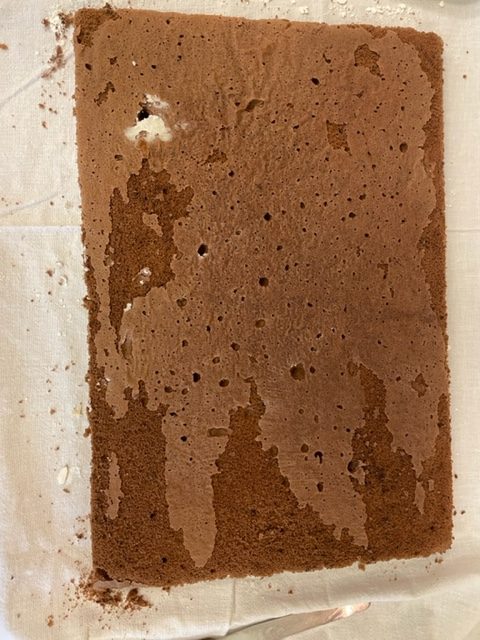
I've been looking at shortcake molds and/or small Charlotte molds. Somewhere I have a 9" Charlotte mold, but I can't find it! But making the genoise as a sheet cake worked well. For a fancy plated dessert, I'd think about using a fluted ring to cut 3" circles of genoise.
We had some of the chocolate genoise with strawberries and a little milk, and then tried drizzling some chocolate ganache on it, too. Both very good. The chocolate in the genoise could be a little more assertive, I may try either using dutch chocolate or increasing the amount of cocoa. (We're kind of spoiled by the CHOCOLATE in crazy cake or Texas Chocolate Sheet Cake.)
The plan for tomorrow is to make some pastry cream and try cake, pastry cream, cake, ganache and strawberries. (It needs a fifth component, maybe some chopped pecans?)
I'm probably going to freeze half of what's left (12 pieces roughly 3x3.)
The low here tonight is currently predicted to be 37, the prediction just went down a degree again. Wind from the NNW which is right into the garden, so I'm hoping it doesn't get so cold it affects my garden.
I made 2 loaves of semolina bread today plus a 10x15 chocolate genoise, which we will cut into squares and have with strawberries for dessert. I used Susan Purdy's recipe, it was fairly easy to follow.
Attachments:
You must be logged in to view attached files.This Ginsberg recipe (Danish rye or ragbrot) starts with an overnight scald/soaker of rye flour, sunflower seeds and flax seeds, so that may soften the flax to the point where some of it can be digested.
I'm also planning to make semolina bread today and a chocolate genoise sheet cake (to go with some fresh strawberries.) Taking advantage of the weekend's cool temperatures!
-
AuthorPosts