Search Results for ‘(“C’
-
AuthorSearch Results
-
February 26, 2023 at 12:37 pm #38558
In reply to: What are you Baking the Week of February 19, 2023?
Over proofed dough can sometimes be punched down and allowed to rise another time (not as long), but as Mike notes, it will not rise as high. I have done this with a set of loaves when we did not get back from a walk in time.
I usually get my lame wet when slashing breads. It seems to help.
Skeptic--I will post the oat cake recipe. They do require Bob's Red Mill Scottish oatmeal, which has a different texture from rolled or steel-cut oats. I adapted the recipe from one on the bag to avoid the butter. These are only faintly sweet, and people biting into one the first time usually expect more sweet. They are somewhat like a cracker. They would do well with cheese, and I also like a smear of jam on them, but plain is fine as well.
February 25, 2023 at 9:27 pm #38549In reply to: What are you Cooking the Week of February 19, 2023?
We had theatre tickets this afternoon (Legally Blonde) and were kind of tired afterwards, so Diane had some soup and I had some leftover spaghetti.
February 23, 2023 at 5:27 pm #38530In reply to: What are you Cooking the Week of February 19, 2023?
As I understand it, meat needs to reach a designated internal temperature to be safe, either a sufficiently high peak temperature or a lower temperature for some period of time. With something like a steak, it is usually assumed that any bacteria will be on the surface, which gets much hotter than the innermost part of the steak, which is why a rare steak is generally considered safe, though restaurants may warn about undercooked food to keep the lawyer happy.
Sous vide cooking works by keeping it at a lower temperature for a longer time. A similar process is used for pasteurized eggs, they get to some specific temperature (around 123 degrees) and have to be held there for something like an hour.
I have a mini crock pot that I use for hot fudge, which needs to be kept at about 110 degrees, or it will separate or scorch.
I found a Lutron plug-in lamp dimmer that allows me to set the crock pot to that temperature. I haven't seen any signs of it damaging the crock pot, but I assume it wouldn't work with one that uses electronics.
February 22, 2023 at 7:17 pm #38519In reply to: What are you Cooking the Week of February 19, 2023?
I love my ChefAlarm (mine's green). I use it for everything - the pot clip is useful. I even use it to manage my cooking in my fast slow cooker.
February 22, 2023 at 6:31 pm #38518In reply to: What are you Cooking the Week of February 19, 2023?
I recently bought a Thermoworks ChefAlarm to replace my CDN candy thermometer. Like many digital thermometers, it has a clip that allows the probe to hang on the side of your pan without touching the bottom. (And it came in purple.)
I've used it a few times for cooked sugar candies.
It comes in a nice pouch that makes it easy to store in a drawer without the cord getting all tangled up.
February 21, 2023 at 6:24 pm #38513In reply to: What are you Baking the Week of February 19, 2023?
I baked the Apple, Barley, and Olive Oil Cake again on Tuesday, with the same changes as a couple of weeks ago. The recipe has been adapted to the point that it is now truly mine. This time, I baked it in a 6-cup heart Bundt pan (I could not resist the new one from Nordic Ware) and a 3-cup Kaiser Backform mini-Bundt pan. The 3-cup pan took about 35 minutes to bake. The 6-cup heart required 45 minutes. Both released perfectly from the pan (love The Grease). I will freeze the small one for Dessert Emergencies, and we will begin eating the other one tomorrow. It will fit nicely on a heart-shaped plate that I bought some years ago from King Arthur--back when they had more interesting offerings.
The 3-cup small Bundt came in a set of two and was called Kaiserguss, with the box stating "original Kaiser Backform." However, it had a "made in China" sticker on it that I only saw after I bought it some years ago at T.J. Maxx. Otherwise, the box looks just like the German ones. I do not know if that means Kaiser Backform moved stuff overseas. However, the pan performed admirably, so I am glad that I bought it. In a two-person household, smaller cakes are the way to go.
February 21, 2023 at 4:31 pm #38509In reply to: What are you Baking the Week of February 19, 2023?
I think the latest semolina dough would have benefited from some stretch-and-folds, that does seem to help the shaping.
My baguettes often looked like a snake that swallowed 3 rats, though I found with practice I got better at it, I think the pre-rolling part of the shaping is key. I watched the staff at SFBI roll out baguettes during one of the lunch breaks when I was taking my pastry course, they even let me roll out a few, and said I was doing pretty good, though they were much faster.
One of the advantages of making epis de bles is that the cuts tend to mask the uneven-ness of the baguette. (And it definitely maximizes surface area, the crusty outside is the best part of a baguette, IMHO.)
One of the things I noticed from the picture yesterday is that the sesame seeds are heavier on one side than on the other, probably has to do with the angle at which I hold the shaker. I thought this batch had enough seeds on them, my wife commented on the previous batch that there weren't many sesame seeds at all.
I think Hamelman recommends dipping the shaped loaf in a tray of sesame seeds, which is probably a lot faster in a production shop. (As I noted in a recent BBGA thread, a lot of production practices are geared towards speed and consistency.) I've always thought that might wind up with too many sesame seeds on the loaf, maybe next time I'll try it. I always wind up with a lot of them falling off the loaf and going to waste on the parchment, presumably any that don't stick would just fall back into the tray.
February 20, 2023 at 11:49 pm #38506In reply to: What are you Baking the Week of February 19, 2023?
Artisan to me means meeting a high standard of quality and consistency, and the latter includes shaping, proofing and baking.
There has been an interesting thread in the BBGA forum lately, and one of the full-time bakers made a comment about a loaf (one that probably looked better than my latest semolina bread) that I think defines the standards an artisan baker tries to meet:
I wouldn't present that loaf at the end of a practical baking assessment and expect to pass.
Loaves that are by design not uniform (or at least close to it) might be called 'rustic', I suppose.
February 20, 2023 at 6:13 pm #38503In reply to: What are you Baking the Week of February 19, 2023?
You could always call the loaf "Artisan," Mike. 🙂
On Monday, I baked "Authentic Italian Lemon and Ricotta Cookies (no butter)" from Elena Paravartes' blog, Olive Tomato. I always replace half of the flour with white whole wheat flour. Today, I further experimented to see if I could reduce the ricotta from 8 oz. to 5 oz., which is what I had left after baking the Turkey, Spinach, and Mushroom Lasagna on Saturday and reducing the ricotta in it to 10 oz. As an additional, unplanned, experiment, my husband reminded me as I was baking the first tray that we were due at the CPA's office to go over our return forms. I had to leave the second tray unbaked for the half hour we were gone, then bake them upon our return. The gap in time did not affect the cookies. I taste tested one from each batch for dessert tonight, and the second batch is identical to the first. The reduced ricotta makes them a bit firmer, but we do not mind it.
February 19, 2023 at 11:42 pm #38497In reply to: What are you Baking the Week of February 19, 2023?
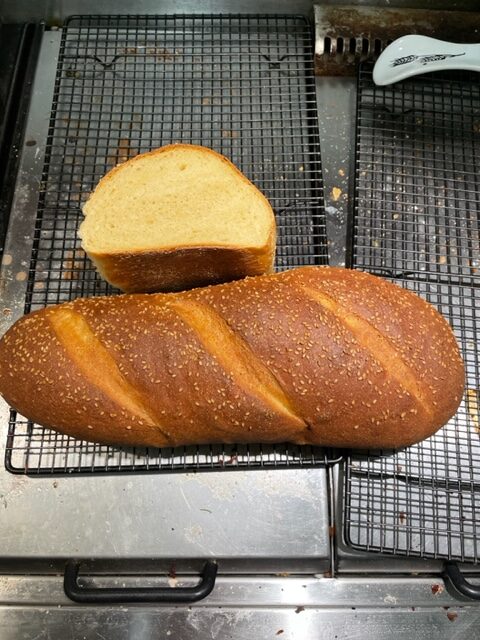
Today's semolina bread came out pretty good, nice oven spring, decent crumb, though it did sort of blow out a little at one end, I think it needed a little more proofing. My shaping was a bit imperfect, too, my goal is to get the middle 2/3 of a loaf to have the same size (width and height) so that the slices are more uniform for sandwich making.
The changes I made (ratio of semolina/durum to bread flour, adding OJ, lower baking temperature) all seemed to have positive impacts, the crust isn't quite as dark or thick and the bitter taste from the bran is either gone or lowered to the point where it isn't obvious.
Attachments:
You must be logged in to view attached files.February 18, 2023 at 11:07 am #38479In reply to: What are you Baking the Week of February 12, 2023?
Aaron--Deb Perelman has a recipe for "Olive Oil Shortbread with Rosemary and Chocolate Chunks" (p. 210), in her second cookbook, Smitten Kitchen Every Day. I have not tried baking it; I'm not sure about the rosemary, (1 tsp. fresh rosemary) and she also specifies mild olive oil, which is not an ingredient that I have in the house. She does say for a milder flavor, replace half of the olive oil with a neutral oil.
I could try it with 75% neutral oil and the rest olive oil, I suppose. However, I think the rosemary might be a no-go with my husband.
February 18, 2023 at 4:45 am #38476In reply to: What are you Baking the Week of February 12, 2023?
Mike, the rye is cool. It looks like a quick bread loaf which you might be able to call it if you hadn't just gone through a multi-day process to make it.
BA - Dorie Greenspan writes wonderful cookbooks. I have two she wrote - one in her own voice and one with Pierre Hermes. I love to look at these but I have used them very sparingly. I am not sure why. The one thing I picked up from her is using brown sugar in my shortbread which adds a nice flavor and snap to the cookie. I'm not sure how you could make a shortbread cookie with oil unless it was one like coconut oil. I'm going to work on finding this for you.
Thanks for the pointers on writing up and scaling starter recipes. I'm going to work on it today. My starter is 100% hydration but then I mix it with flour and water. The last time I made this bread I used
Starter
250 g starter at 100% hydration
125g flour
90g waterDough
Flour 500g
Water 300g (this needs to be higher I think)
Salt 7.5gShould my starter mixture be higher to be 100% of the flour? The original recipe came from Serious Eats at the start of COVID.
February 17, 2023 at 9:54 pm #38475In reply to: What are you Baking the Week of February 12, 2023?
When we were in Germany (nearly 17 years ago) I had some really dark rye bread that I think may have been similar to a Westphalian pumpernickel.
Yes, I think it has some similarity to the wrapped rye breads. And unlike a lot of recipes, it doesn't rely on coffee, cocoa or food coloring to make it dark.
This first loaf mighty wind up being difficult to slice, but I'm hoping the flavor makes up for any slicing issues, and if there's a next time I'll probably add even more water than I did this time.
February 17, 2023 at 9:07 pm #38471In reply to: What are you Baking the Week of February 12, 2023?
Very interesting project, Mike. I wonder if this is like some of the wrapped imported rye breads that we sometimes see at the stores?
I bought Dorie Greenspan's book, Dorie's Cookies, shortly after it came out in 2016. We were in the midst of preparing to move, once we did, we started the house renovation bog down, and then I had a diagnosis of high cholesterol. Almost every recipe in the book relies heavily on butter, so the book has sat unused. However, I was paging through it late last year and found a recipe for "Chocolate Chip Not-Quite Mandelbrot" (104-107) that uses oil rather than butter. While the cup of mini-chocolate chips are little fat bombs, the recipe makes 72 cookies, so I decided to bake it on Friday night. I made just one change by substituting half white whole wheat flour.
The dough was much easier to work with than I had feared. I did use my hand mixer to combine the eggs and sugar, then the oil and vanilla, but I combined the flour mixture and chips with it by hand. They were easy to slice after ten minutes of cooling. I used my offset knife. These go back in the oven with a cut side down and are sprinkled with additional cinnamon sugar. I used the Penzey's cinnamon sugar blend which includes vanilla. The cookies are not the traditional Mandelbrot as they have no almonds and are cakey rather than hard and dry. I ate some crumbs left from cutting them before the first bake and liked the taste.. I look forward to having them with some tea or coffee tomorrow.
February 17, 2023 at 10:15 am #38466In reply to: What are you Baking the Week of February 12, 2023?
I was wondering about how commercial bakeries produce Westphalian rye bread, my wife thinks in volume it might be easier than in small quantities, since commercial mixers are designed to handle stiff doughs better than most home mixers.
The ingredient list is simple enough: 750 grams of coarse rye meal, 750 grams of boiling water for the scald (though I added water, and could probably have added more, I think my rye was more finely ground than a 'coarse meal', and that soaked up a lot of water), another 350 grams of rye meal and 12 grams of salt in the final dough. No yeast. In fact, the scald probably kills off any yeast present in the rye, so what happens during the overnight rest for the scald is amylase activity to break down starch, not yeast activity.
-
AuthorSearch Results


