Sat. Apr 25th, 2026

Search Results for ‘(“C’

Home Forums Search Search Results for '("C'

Viewing 15 results - 7,096 through 7,110 (of 9,560 total)
  • Author
    Search Results
  • #5241

    In reply to: A basic baking library

    BakerAunt
    Participant

      Susan Purdy's book's title was changed to The Perfect Cake. It is a lot friendlier than RLB's cake book. I agree that it belongs in every baker's library. I hope to get my hands on her pie book one of these days.

      My list would include the KAF Wholegrain Baking Book, because it does discuss techniques for incorporating wholegrains and got me to bake with a wide variety of flours--which is why we need two refrigerators. I also like Bernard Clayton's The Complete Book of Breads, although the recipes use more yeast than necessary, which was typical of bread books of that time, and so need to be adjusted.

      This topic made me realize that I've been doing a lot of my baking from the KAF site, some magazines, some e-mails, and this site (and once the Baking Circle). With my cookbooks, I seem to pull from various ones at different times. I probably use the KAF 200th Anniversary Cookbook more than the KAF Cookie Companion or KAF general baking book.

      • This reply was modified 9 years, 6 months ago by BakerAunt.
      • This reply was modified 9 years, 6 months ago by BakerAunt. Reason: proofreading error
      • This reply was modified 9 years, 6 months ago by BakerAunt.
      Mike Nolan
      Keymaster

        I think they look OK for home-made candies, I suspect Chef Russ would say they might not look so good in a display case. If I want to take Chocolate 2.0 some time next year (Chocolate 3.0 is the course I really want to take, that's where you redesign ganache recipes), I need to hone my skills, those courses are geared for working professionals.

        I'm not looking to make show pieces or fancy plated desserts, though the chefs at the Chocolate Academy presented several examples of their wares at lunch, and they were all restaurant-worthy.

        luvpyrpom
        Participant

          Mike, those chocolate candies look yummy!

          Italiancook, I use a rice cooker, it's a small one I got from Target. I do cook my brown rice on the stovetop. One tip if you do get a rice cooker, do not wash your rice in the cooker. With the swirling and water when you wash the rice, it can scratch the nonstick surface. I've learned (the hard way) of washing the rice in separate bowl and then putting it into the cooker. And as it's just my mother and I eating the rice, I just make a pot, keep extras in the frig and microwave the leftovers. You can also freeze rice, too.

          What I made this past week was beef burritos without cilantro for my work lunches. I wrap each one in saran wrap, place in ziploc bags, and freeze. I just take what I need for lunch that day. Otherwise, not much else other than the basic beef pot roast and/or take out for the week.

          #5229
          Mike Nolan
          Keymaster

            I've tried making a four-strand braid and a five-strand braid, but I haven't tried a six-strand yet. (I've seen instructions for eight- and nine-strand braids!) Anything beyond three-strand would take a lot of practice, I suspect.

            A suggestion I've made before to practice complex braids is to get some thick macrame yarn.

            #5228
            Mike Nolan
            Keymaster

              If you were asked by someone to recommend a few books on baking to start a library for aspiring bakers, what books would you recommend?

              I'd want at least one of Peter Reinhart's books, probably The Bread Baker's Apprentice. The Artisan Bread Every Day book would be a close second choice, with his Whole Grains book 3rd, or 2nd for those who have a strong interest in whole grains baking. (I haven't looked at his most recent book yet.)

              It isn't a baking book, not even a cookbook, but I'd probably include Harold McGee's On Food and Cooking: The Science and Lore of the Kitchen. There are cookbooks that tell you what to do and there are books that tell you why to do it. McGee is one of the latter.

              For pies and cakes, I'd go with Susan Purdy's books, As Easy as Pie and A Piece of Cake, although I think the latter book has changed title in its most recent revision. Although I'm a fan of Rose Levy Beranbaum's The Cake Bible and The Bread Bible, I find I use Susan Purdy's recipes more often.

              That's my starting list, what's yours?

              #5227
              Mike Nolan
              Keymaster

                If you're having trouble getting a thin crust pizza dough stretched out really thin, it's probably due to your flour. You need less elasticity (glutenin) and more plasticity (gliadin.) Mind you, I know of no flours available in stores that will tell you what the breakdown of gluten proteins is.

                McGee says that one of the ways to add gliadin and increase the plasticity of dough is to add durum wheat, ie, semolina.

                Mike Nolan
                Keymaster

                  I've got a Zojirushi rice maker, I've used it to steam vegetables and cook custards, but mostly I use it for rice. I've wondered about using it to make a Boston Brown Bread, which is basically a steamed pudding.

                  It is a simple cooker, No settings dial, just push the lever down. For some types of rice adjusting the amount of water up or down is advised.

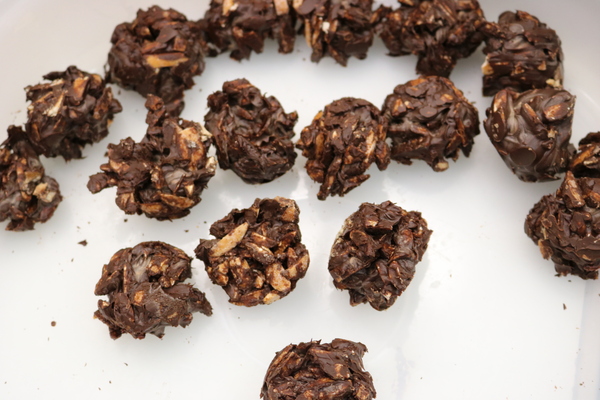
                  This past week I made a couple of test batches of almond rocher haystacks, and one small batch (20 haystacks) using a dark milk chocolate, mostly to test my chocolate tempering pot. The next batch will be made using Ghiradelli milk chocolate coating, I like the dark chocolate ones but my wife thinks they're a bit overpowering.

                  Haystacks

                  BakerAunt
                  Participant

                    Italian Cook: The rice maker does result in less sticky rice. I have two very simple Black and Decker ones that I bought at Ross. I bought the 4 cup one first, and I found myself carting it back and forth to our place in Indiana, so I left it there and bought a somewhat larger one for here, since at the time two of my stepchildren still lived with us. I continue to use the large for just the two of us, and it will cook just two cups. However, cooked rice can be frozen quite nicely. Rice reheated in the microwave is not sticky at all.

                    While many rice cookers have complicated bells and whistles, this one is simple: Push the button down and when it pops up, the rice is done. There are even different water fill lines for regular rice and brown rice. I have found that it is not a good idea to let cooked rice sit on the "warming" setting (what the rice cooker switches to when done). I pull the insert out and put it on a hot plate. My rice cooker also has a steamer insert, and I've occasionally steamed vegetables in the insert (although never while the rice was cooking). The nonstick pan is an improvement over the old ones that did not have nonstick.

                    • This reply was modified 9 years, 6 months ago by BakerAunt.
                    BakerAunt
                    Participant

                      On Sunday, I baked Spiced Oat and Pear Scones, an online recipe from Real Simple. I mixed up the dry ingredients the night before, cut in the butter, and refrigerated overnight. 1 substituted one cup of whole wheat pastry flour for one-third of the regular flour (KAF). On Sunday morning, I added the diced pears, then the milk, shaped, cut, and baked. The scones are ok but nothing special. I will not bake this recipe again. I froze six of them for quick breakfasts later on, since with the warmer weather I know they will not keep at room temperature for more than a couple of days. Friday evening, I baked pizza, using the KAF thin-crust pizza recipe. On Saturday I made pumpkin bread as six mini-loaves, using Beatrice Ojakangas' recipe from Quick Breads, but I substituted in a cup of white whole wheat flour and added a tablespoon of flax meal. I also baked a double recipe of sugar cookies, from the Nordic Ware Geo cookie stamp box, but I used the new set of Halloween cookie stamps that I bought on sale from Sur la Table. I substituted in a cup of white whole wheat flour. The pumpkin bread and cookies will fulfill several functions: the social time after church, a gift for a former student of mine visiting friends in town with her husband this weekend, and dessert for our family on Sunday.

                      Note: Maybe it was this cookie recipe, but I was not impressed with the Nordic Ware Halloween stamps. The cat and the spider made a passable design, but the pumpkin barely shows up. I'll use a different cookie recipe next time I make them.

                      • This topic was modified 9 years, 6 months ago by BakerAunt.
                      #5205
                      cwcdesign
                      Participant

                        Aaron, another interesting site I have been following (although I haven't been making much pizza lately) is the Baking Steel site http://www.bakingsteel.com/pizza-blog/

                        They have posts from Peter Reinhart and Kenji Lopez-Alt as well as a variation on the no-knead I want to try. Obviously, the purpose is to sell baking steels, but it's still very interesting.

                        #5198
                        Mike Nolan
                        Keymaster

                          I do know the legend/story of Ike Sewell. There are at least two pizza places in New York that claim to have been the first to have made pizza in the USA, I think there was even a lawsuit over advertisements.

                          There was a lot of crossover in styles, as most pizza places made several types. And as I recall, the Chicago Magazine article in the mid 70's was criticized for having left out several types of pizza, so an argument could be made that there were several distinct styles of deep dish, of thin crust, etc. I also recall the war between Uno's and Due's, though some of us thought it was an advertising stunt. (Philly still has its cheese steak wars and there used to be a lot of discussion in Chicago over who made the best Italian Beef, too.)

                          But at least in the 70's (when we lived in Chicago), thin crust was more of a north side style and deep dish a south side style, though Gulliver's (on Howard) made a really good deep dish pizza back then.

                          As some of the chains, notably Giordano's, became dominant in the 80's, the geographic distribution largely went away. Old north-side thin crust seems to have vanished, Rick's and Pizza Oven closed, My Pie moved and (I'm told), changed styles.

                          There are a lot of competing claims as to who invented deep dish and who invented stuffed. Thin crust is closer to the style of pizza we found in Italy when we were there, but we were in Turin, and there's probably a lot of regional differences in Italian pizza (like there were in Chicago 40-50 years ago), and it would take a serious pizza crawl to document them. If someone wants to crowd-fund me on such a trip, I'm game!

                          • This reply was modified 9 years, 6 months ago by Mike Nolan.
                          #5197
                          Mike Nolan
                          Keymaster

                            The best book on Chicago pizza is probably the Great Chicago-Style Pizza Cookbook. I believe it is available through Amazon, though I think I bought it in a gift shop at O'Hare Airport. It has a number of different dough recipes (over a dozen, I think) plus a number of sauce recipes.

                            The pizza dough recipe I have posted here is my variant on one from that book. (I tinkered with the ratios slightly and added semolina.)

                            There are a number of pizza websites, including Peter Reinhart's Pizza Quest site. I don't recall if Peter has any Chicago-style dough recipes, but as I said in another thread, I'm not convinced he really 'got' what Chicago pizza was about.

                            I'm a big fan of both deep dish and stuffed, but I really liked thin-crust, which was one of the five distinct styles of Chicago Pizza that Chicago Magazine identified in an article in the mid 1970's, though it seems to have largely disappeared in Chicago these days.

                            The five styles, and some of the places that specialized in them, at least 40 years ago, were: deep dish, stuffed, thick crust, ultra thin crust and pizza bread. Deep dish originated on the south side (Giordano's), stuffed on the west side (Nancy's), thick crust was near-north (Pizzeria Uno), thin crust was north side (My Pie, Gulliver's, Pizza Oven, Rick's) and pizza bread was common in several areas, though Gulliver's had the best at the time. (When new owners came in at Gulliver's, the story was that they changed the recipe to save on costs, and I'm told the quality suffered badly.)

                            When I was at Northwestern, there was a pizza place on Central (The Inferno) that made double-dough pizzas where the dough must have been 2 inches thick. I thought they were awful, but for college students on a budget they were cheap and filling.

                            The two best thin-crust recipes I've found were the 'Roman' dough in Peter Reinhart's book, American Pie, and this one: Thin Crust Dough Recipe. When I say 'thin crust', I mean REALLY thin, you should be able to read newsprint through the dough after it's rolled out! This requires a dough with a lot of extensibility in it, though I can't remember which of the two gluten proteins that is.

                            #5196
                            aaronatthedoublef
                            Participant

                              The only nit I have to pick is Mike characterizing the Chicago style of thin crust as being "North side". As a fourth generation South Sider there was and is plenty of the distinctive, ultra-thin pizza on that side of town too. In fact, the legend of Ike Sewell (https://en.wikipedia.org/wiki/Ike_Sewell) aside the first place in Chicago to server pizza was a tavern in Hyde Park called Ken and Jacques's. In the late 50s Urban Renewal razed the entire block and Ken and Jacques's became a group of row houses one of which became my family's home.

                              #5190
                              Mike Nolan
                              Keymaster

                                I got started making the almond rocher last night, boil almond slivers in a sugar solution for 2 minutes then toast them in the oven until they caramelize.

                                They're delicious before I even add the chocolate! I'm making two small test batches, one with some milk chocolate and one with Ghiradelli chocolate coating (not a true milk chocolate, as it has palm kernel oil instead of cocoa butter.) I think the Ghiradelli coating tastes funny by itself, but I tried a taste of the leftovers in the bowl after making a small batch of 'haystacks' and it tasted pretty good.

                                #5186
                                aaronatthedoublef
                                Participant

                                  Hi,

                                  I was looking at Jim Leahy's no-knead pizza dough and he does a very short rise of a couple of hours. Has anyone ever tried his recipe and used a long, slow rise?

                                  Our pizza dough typically sits in the refrigerator for as long as 72 hours (this is based on a cooking class I took in Italy many years ago).

                                  I am giving a pizza talk in November and want to give people several different ways of making dough including a no knead so they know that a stand mixer or 10 minutes of kneading dough is not required. I want to lower the barrier to entry.

                                  On a tangent, I usually add some sugar to feed the yeast - usually a teaspoon or so. Would I be better off dropping that for my slow rise?

                                  I use close to 3 cups of water and about 6-7 cups of flour. I use a mix of white whole wheat and cake flour with some flax meal thrown in.

                                  Thanks

                                Viewing 15 results - 7,096 through 7,110 (of 9,560 total)