Search Results for ‘(“C’
-
Search Results
-
Finnish Christmas Bread
Hi all,
A friend of mine has been telling me for years (and years!) about a bread her aunt used to make. She could never tell me much about it so I could try to duplicate it for her, except that it was sweet-ish. During a house move this fall, she came across her aunt's recipe (from back in the 60s, complete with the splotches of a well-loved favorite recipe) and sent it to me asking that I make it for Thanksgiving. It's a basic sweet dough with the addition of cardamom, so nothing difficult there. It calls for 8 cups of flour, which is entirely too much for our small group, so I want to halve it. Here's the ingredient list:2 pkg. active dry yeast
1/2 cup water
1 1/2 cups milk
1 cup sugar
1 tsp salt
1 tsp cardamom
4 eggs
8 cups AP flour
1/2 cup melted butterSeems to me I'd be OK just halving the ingredients as listed, right? I'll definitely use SAF gold yeast with all that sugar (I think that's probably why 2 pkg. of yeast are used in the original recipe). I've compared it to other sweet dough recipes, and I think the halved proportions would be OK. I don't do sweet doughs much, so I thought I'd get some input from all of you.
thanks,
Karenposted by: karen_noll on November 24, 2013 at 2:49 am in General discussions
reply by: dachshundlady on November 24, 2013 at 7:54 am
I'm no baker chemist, I'll let others comment but it looks delicious. I love cardamon breads. Please post back with results.reply by: KAF Customer Support on November 24, 2013 at 9:19 am
Karen, your instincts are exactly right. You may simply halve all of the ingredients to make a smaller loaf. Best of luck. ~Jaydl@KAFreply by: ncgnet on November 24, 2013 at 9:47 am
In my recipes you'll find "Swedish Cardamom Braid or Buns" which is very similar but makes a smaller amount - it only calls for 1 egg, four cups of flour, etc. It makes either three small or two larger braids. Maybe that would work for you.reply by: ncgnet on November 24, 2013 at 9:49 am
PS:
Forgot to mention that for me, the cardamom is an essential flavor for these breads (Finnish, Swedish, etc.) and I notice your recipe halved would only have 1/2 teaspoon. Depending on how much you like cardamom you might consider keeping the amount at a full teaspoon.reply by: 4paws2go on November 24, 2013 at 9:37 am
Hiya, Karen! That's very close to a recipe I had been using, to make Pulla bread, for a good friend of Finnish descent. I found mine in the 'Ellis Island Immigrant Cookbook'. My friend Eileen was always reminiscing about how WONDERFUL her grandmother's kitchen smelled, when this bread was being baked. She said her family just called it 'coffee bread', but would make it into specially shaped loaves, for Christmas. Normally, it was done as a braid.
.
The first time I made it, and brought it over to her, she'd been writing an essay (she was taking writing classes at that time) all about her grandmother, and actually started crying, as soon as she saw and smelled the loaves...We also took the other loaf to her father, who was in his early 90's, and he gave it the thumbs up, so that sealed the deal, for me...lol!
.
I am trying to read from my scribbled notes, so allow for boo-boos...
.
20 oz. flour
water 2 oz.
milk 7 oz.
eggs 2 (also one for egg wash)
melted butter 4 oz.
sugar 3.5 oz.
salt 1/2 tsp
yeast 2/14 tsp SAF Gold
cardamom 1 heaping tsp ( I grind it fresh)This makes two loaves, and the original instructions call for braiding, egg wash, and sprinkling with coarse sugar, bake at 350F, for approximately 25-30 minutes.
It is DELICIOUS!
Laura :0))))reply by: KitchenBarbarian aka Zen on November 24, 2013 at 11:17 am
make sure it's ground cardamom, not the whole seeds (little black pellets) - they are SUPER nasty if you get ahold of a whole one. I love the flavor, but not that concentrated, LOL!reply by: dachshundlady on November 24, 2013 at 11:26 am
Loved that story 4pawsreply by: karen_noll on November 24, 2013 at 11:47 am
Thanks, everyone for all the input! I'll let you all know after TDay how it went.
Karenreply by: ncgnet on November 24, 2013 at 11:51 am
My mother's family was Swedish, but one uncle married a woman whose family was Finnish. She was a wonderful person who made the best dinner rolls ever. We kids used to call them "bullets" and I didn't know why, they certainly weren't hard. Then, as a young adult, one of my friends gave me her family's recipe for Pulla, and the penny dropped. Good thing my aunt had a sense of humor!
.
Nancyreply by: karen_noll on November 24, 2013 at 11:59 am
Hey Laura,
The recipe as given to me is from a newspaper article from 1967, and has descriptions for various traditional shapings, such as Lucia's Crown, Christmas Star, Golden Chariot, Pulla (which is I think the braid you mentioned), and my fave Bishop's Wig......unfortunately, the illustrations are missing, but I just love the names. I think I"ll do a trial run before Thursday just to see how the cardamom level is and how it works with the SAF gold yeast. Ironclad rule: NEVER make anything for the first time on a holiday (as me how I know...)
Karenreply by: 4paws2go on November 24, 2013 at 2:08 pm
This discussion brought back memories of one of our 'old BC members'...tuuliki...she always ended her posts with "Eat More Pulla"!...lol! I forget if I'd saved her personal recipe for the bread, but I'll check. Eileen (my friend) said they also sometimes called it 'Nisu', but more commonly called it Pulla.
.
Typo in my posting, oven temp 350F.And, yeah....the tiny cardamom seeds, MUST be ground quite finely. I just buy the whole pods, at the Indian grocer, and grind as needed, for baking, and then I have them on hand for cooking, etc.
It really is lovely stuff, especially for members of the Cardamom Adoration Society.
Have fun!
.
Laura ;0))reply by: frick on November 24, 2013 at 3:27 pm
Karen, I can't wait to hear how your Cardamom bread turns out. Even though I don't bake with it, I bought some . . . instinctively, I thought 1/2 tsp. for half the loaf seems like not very much. So, do let us know. I want to try one of these breads! Copying them all.reply by: 4paws2go on November 24, 2013 at 6:31 pm
Here ya go, Karen...probably much like the one you've got on hand...I'd saved tuuliki's to my recipe box...:
.
http://community.kingarthurflour.com/node/5024[uploader's note: does someone have the recipe? the link is no longer active].
Laurareply by: karen_noll on November 25, 2013 at 4:50 am
Yup, it's almost identical.
And now that I see all these very similar recipes, it reminds me that I was on a hunt for cardamom bread a couple of years ago after visiting Ten Chimneys, the Wisconsin summer home of Alfred Lunt and Lynn Fontaine of mid-20th century Broadway fame. They hosted great house parties with glittering guest lists, and were known for the great food served at these parties. One of the house breakfast favorites was Mr. Lunt's cardamom bread....the very same recipe we've been talking about! Guess I've come full circle!
thanks,
Karenreply by: karen_noll on November 26, 2013 at 5:52 am
Did a test run yesterday in my Zo on a half batch, and only had to adjust the flour a little by adding a few tablespoons. Very tasty, not too sweet, makes great toast. The 1/2tsp of cardamom was not really noticeable, but there was just a hint of "something". Those of you who are members of the Cardamom Adoration Society might want to go for a full tsp even for a half batch. Four cups of flour makes more dough than will work well in a 9x5 loaf pan (which is what I used), so I wound up with a mutant mushroom loaf. I baked the loaf at 375 for about 30 minutes, tenting with foil for the last 5 minutes or so.
Karenreply by: kathyd on November 26, 2013 at 8:03 am
Karen,
I make a Pulla quite often. My mom loves the cardommon too.
I've never put it in a loaf pan. Always braided the loaf - no mushroom bread there.
Good luck and Happy Thanksgiving!
KathyDreply by: karen_noll on November 26, 2013 at 8:11 am
Happy Thanksgiving to you, too! I thought of doing a braid, but I was really only interested in taste and how the dough performed. Not sure what I'll do with it on Thursday. I think my friend wants dinner rolls, but maybe I'll get a little festive and make knots. I hope she likes it as much as she remembers.....
Karenreply by: kathyd on November 26, 2013 at 3:29 pm
It's funny how somethings we remember aren't quite always as we remember them.
Don't know if the ingredients change over time or what it is....sometimes it just isn't the same.
Good luck and I hope she loves it.
You are such a nice friend to do this for her.
KathyDreply by: karen_noll on November 26, 2013 at 5:04 pm
Holiday dinners at her house are a group effort. Everyone brings a thing or two, so me bringing bread is a good fit. I hope she loves it, too. She doesn't like cardamom, so she asked that I leave it out, and it tastes like every other sweet dough I've ever had. I only added some cardamom yesterday to see how it tasted. It may be a non event for me, though, I sprained a toe last night (I tripped over the bread machine if you can believe it...). I'm still hobbling around and can't get into a shoe, and since my car has a manual transmission, I'm not sure I can drive, either. I'll see how it is on Thursday.
sigh.....reply by: frick on November 26, 2013 at 5:37 pm
I keep telling my DH about the things I would never have known had it not been for this forum. Yesterday, I got a new book set in Finland, quite by accident. There leaping out at me was this line,
.
"He has his sh#% together. He's showered, dressed, made coffee, and has pulla . . . hot from the oven in case we haven't eaten".
.
I mean, really, gals. How many times have I ever heard of pulla? About as many times as a bird has fingers . . LOLreply by: dachshundlady on November 26, 2013 at 6:29 pm
Karen, I hurt my rotator cuff a couple years ago. At the time I had a manual transmission Mini Cooper Clubman. Between the injury, the heavy doors on car and my shoulder, I decided to trade it in. I now have an automatic Toyota Matrix. Much easier though not nearly as cool as the Cooper!reply by: bakeraunt on November 26, 2013 at 6:35 pm
My husband is not fond of cardamom. I, however, had a Swedish grandmother I never got to meet, so maybe I have a genetic disposition to be fond of it. I bake a Swedish Coffee Ring for Christmas with an almond paste filling, and I note that he eats it and does not mind the cardamom. I did overdo cardamom one year in Hot Cross Buns, probably because my cardamom seeds were newly purchased, and the flavor was a lot stronger than what I usually used; it toned down a bit with age. I have agreed to leave it out of the Hot Cross Buns, but it is staying in the Swedish Coffee Ring.
.
I buy the white cardamom from Penzey's, open the pods to take the seeds out, then crush them with a mortar and pestle until it is a fine powder.
.
I will have to try the Pulla--and not tell him it has cardamom in it!reply by: dachshundlady on November 26, 2013 at 7:45 pm
Oh man, bakeraunt. Cardamom AND almond paste. My dream sweet.reply by: karen_noll on November 26, 2013 at 8:26 pm
I've been buying cars with manual transmissions for a good long time now. Only ever had one automatic, and I felt like a passenger rather than a driver. I'll deal with the sprain, won't give up the car. One of these days they just won't make cars I want in five speed, and then I'll have to deal, but not just yet......reply by: bakeraunt on November 26, 2013 at 9:04 pm
My husband and I have a mixed marriage: he insists on manual transmission, and I insist on automatic.reply by: KitchenBarbarian aka Zen on November 26, 2013 at 10:17 pm
BWAH HA HA HA HA! Mixed marriage indeed!
.
I have tried for years to convince my son to learn to drive stick. He utterly refuses. I even tried to pull this on him while he was in high school:
.
"What will your friends think when they find out your mama can drive stick but you can't?"
.
"Mom, you taught me not to CARE what other people think!"
.
*sigh*. How our good intentions DO backfire on us! LOL!Queen Guinivere Cake Flour
Why can I no longer find Queen Guinivere cake flour. It is the best I have ever used and do not get the same great results with the King Arthur cake flour. I hope to see it's return soon.
posted by: rjdean528 on August 15, 2014 at 11:51 am in General discussionsreply by: KAF Customer Support on August 15, 2014 at 12:38 pm
rjdean528,
As of fairly recently, we have chosen to discontinue the Queen Guinevere Cake Flour and it is no longer available. A primary reason behind this decision is that this was the only flour KAF offered which was bleached--an industry standard practice for that type of flour. Our preference is to offer only unbleached flour to our customers and community. We are sorry to learn that this will leave you without a product you'd come to love using, and I will be happy to share your feedback with our Merchandising Team for their future consideration.If you have any questions about using or adapting our Unbleached Cake Flour, please feel encouraged to give our friendly Baking Specialists a call at 855-371-2253. Happy baking!
Jesse@KAFreply by: KIDPIZZA on August 15, 2014 at 12:59 pm
RJDEAN:
Good morning. There are those who will propose to you that you can make your own cake flour by mixing two flours together...yes you can get your accepted protein level that you chose for your baked product.
.
The problem is this maneuver does not have the moisture absorbing ability as does "CAKE FLOUR". CAKE FLOUR is milled to handle more sugar & moisture that the other flours cannot thru the use of particular bleaching & other chemicals. This flour is designed to handle the butter (FAT) in its best optimum way for your baked product..
.
As you know, there are two brands of cake flour in the super markets, one is called "SOFT AS SILK" The other right now I cannot remember its name. I have used both & I do not think that one any better than the other.
.
If you expect to end up with a cake that you can slice up with a feather than employ a "CAKE FLOUR" & not one that is homemade.
.
I hope this info helps you to make the best decision for yourself.
.
Enjoy the rest of the day my friend.
.
~KIDPIZZA.reply by: bakeraunt on August 15, 2014 at 1:58 pm
Here's a recent thread that discusses what other brands of cake flour people are using:
http://community.kingarthurflour.com/content/what-kind-cake-flour-do-you...
[uploader's note: no longer exists?]reply by: aaronatthedoublef on August 15, 2014 at 9:28 pm
Yes, I started that post when I noticed Queen Guinevere was no longer available.
I too am very disappointed that KAF decided to jettison Queen G. It has been a staple in my pantry for years now. I have about nine pounds left and that should last me about three months.
I know it's bleached but it works for me and the KAF cake flour blend doesn't work right in my recipes. So I guess I will have to find something new.reply by: Antilope on August 15, 2014 at 9:50 pm
There are three main brands of bleached cake flour still generally available:
.
Pillsbury Softasilk Bleached Cake Flour
Swan's Down Bleached Cake Flour
Presto Self-Rising Bleached Cake Flour. (with baking powder and salt added)reply by: Maryarias on August 20, 2014 at 8:47 am
I have tried making this bleached cake flour but something went wrong and it was not good in taste.reply by: Mike Nolan on August 20, 2014 at 6:36 pm
Haven't tried this yet, but it sounds interesting: kate flour (heat-treated flour)
#reply by: Antilope on August 20, 2014 at 9:05 pm
This sounds as interesting and revolutionary as the tangzhong technique for bread. I can see the look on my wife's face when I start microwaving dry flour. ;-). I have to try this, thanks for posting the link.
.
Here's a condensed version of what "Kate Flour" is:
.
I haven't tried this yet, but it appears to be very interesting. It involves making cake flour from unbleached all purpose flour.
.
For those that are concerned about bleached cake flour and the chemicals used to create it, there appears to be an alternative.
.
Dry, unbleached all purpose flour is heated to 266-F (130C) in a microwave, cooled to room temperature and mixed 1/8 by weight with cornstarch making a homemade unbleached cake flour with the characteristics of bleached cake flour.
.
In Europe and Australia bleached flour was banned in 2007. People there missed bleached cake flour.
.
Someone developed a homemade replacement for bleached cake flour by heating unbleached all purpose flour in a microwave to 266-F (130C) and allowing it to cool to room temperature. It is then mixed 1/8 by weight with cornstarch to lower the gluten content.
.
Heating dries out the flour and ruptures the surface of the flour starch molecules, changing its characteristics to that more like bleached cake flour. In cooling, the flour re-absorbs its moisture content from the air, but retains good cake baking qualities it obtained from heating in the microwave.
.
Adding the cornstarch lowers the gluten content of the all purpose flour to that more like a cake flour.
.
This homemade cake flour is called "Kate Flour", named for the person that developed it.
.
Here is a link to the blog of the person that created it and also the recipe for making the homemade cake flour from unbleached all purpose flour:
.reply by: frick on August 22, 2014 at 2:12 pm
I guess there's more than one way to skin a cat. Let us know your results and opinion if you try it. I'm one of those who aren't bothered by bleached cake flour enough to care, but hat is in no way a criticism of those who do.reply by: aaronatthedoublef on August 25, 2014 at 12:44 pm
Wow, cool....
Microwaving flour takes less time it seems but using a regular oven takes less intervention. Unfortunately, we don't have a cold oven so I'm not sure I could completely duplicate this.
Also note, though, that baking powders make a difference and kate flour works better with the UK variant than the US version.reply by: aaronatthedoublef on August 25, 2014 at 12:59 pm
What is wrong with bleached flour?
Why did the EU ban it?
Why did KAF discontinue it?
Thanksreply by: Antilope on August 25, 2014 at 1:14 pm
I'm more of a bread baker than a dessert maker. I usually just use cake flour to mix with all-purpose flour to make a lower gluten flour for biscuits, cornbread, pancakes, waffles, etc. Bleached flour doesn't bother me, but if I can't find any this looks like a good alternative.reply by: Mike Nolan on August 25, 2014 at 1:32 pm
It is the EU's mission in life to protect Europeans from anything harmful.
Next I expect them to ban hydrogen dioxide, because it leads to many deaths every year.reply by: Mike Nolan on August 25, 2014 at 1:34 pm
Note for the non-chemists, hydrogen dioxide is H2O, more commonly known as water. 🙂reply by: aaronatthedoublef on August 25, 2014 at 1:43 pm
I think we're all (including KAF) thinking about this in the wrong way.
Sure things can be bleached by using a bleaching agent (like chlorine bleach) but things can also be bleached by heat treating them which is really what is being done when flour is microwaved or heated in an oven.reply by: Mike Nolan on August 25, 2014 at 1:58 pm
As I recall, originally flour was bleached by long term exposure to sunlight and oxygen.
It might be difficult to do that or heat treatment on a production scale these days, and from what I've seen there are some differences between 'kate flour' and bleached cake flour.
#
The point to bleaching is not just to whiten the product, it is also to weaken the flour. Whether heat treatments accomplish that sufficiently is something that might be a job for scientists to investigate, although from what I can tell the academic community doesn't feel that's worth researching.reply by: weedsnstitches on August 25, 2014 at 9:26 pm
If you are in the south, you can get Wondra which is a cake flour. Or use White Lily or Martha White which is soft but not as soft as Wondra. I know White Lily and Martha White are bleached.....
.
But don't use WL or MW for bread as they don't hold together unless you add a lot of gluten. They do a great job for biscuits though. Or anything else you want tender like cookies.reply by: spud14901 on August 26, 2014 at 7:15 am
I think you should let the customer decide. If you said you were not selling enough of it to make a profit, it is one thing. I don't need somebody (big brother) telling me what to buy or not to by. If you don't want to use it at KA that is fine but to take away a product that customers like and support is another.King Arthur is not the only quality product on the market. I am really aggravated over this and I am sure I am not alone. I had an order in my cart that I did not place because of this and it even had free shipping.
reply by: aaronatthedoublef on August 27, 2014 at 11:08 am
Mike,
Thanks. I guess I really am not sure what the big deal about bleaching flour is. I understand people not wanting to consume chlorine but using a bleaching agent like chlorine is not the only way to bleach flour. Of course other ways may not be commercially viable as you point out.Another question is, has KAF actually discontinued Queen G flour? It still shows up here http://www.kingarthurflour.com/professional/flours.html under professional flours as being available through distributors in 50 lb. bags.
Thanksreply by: swirth on August 27, 2014 at 12:12 pm
For the best answer, Aaron, click the Contact button at the top left, right next to the toll-free #, and ask the folks at KAF if you can get the 50# bags...some folks thru the years here have been lucky to find a business near them where they could have a 50# bag of various flours delivered. Maybe you could work something out. Freeze the flour in gallon freezer zipper bags and it will be fine for a long time.reply by: aaronatthedoublef on August 27, 2014 at 3:01 pm
Thanks Swirth. I definitely know people who would buy it for me. Maybe I could even start a side business reselling it to those of us who miss it!reply by: KitchenBarbarian aka Zen on August 30, 2014 at 6:58 pm
Well turn your back for 2 or 3 weeks and see what happens! I'm finally in a place where I might be able to get access to Queen Guinevere in 50 lb. bags and what do they do - stop making it!
.
I'm very sorry, but the KAF unbleached cake flour is awful stuff. You'd do better to stick with Pillsbury or GM "regular" flour, by far. I've tried it. It is execrable. It is NOT cake flour. Everyone I know who has tried it has hated it.
.
The Winco here carries cake flour in bulk for a pretty reasonable price, given what a 2 lb box of Swansoft or one of the others usually costs me (over $2 per pound, it's like 80c in the bulk bin). It cannot possibly be worse than KAF unbleached faux-cake flour.
.
If you can get it, White Lily all purpose flour (NOT the self-rising version) makes a fairly good substitute for cake flour. And btw, WL specifically makes a bread flour - so you can make bread with White Lily flour, it just needs to be the right sort.
.
Otherwise, stick with Pillsbury or GM regular "all-purpose" flour and replace a small amount by weight with cornflour. It also is not optimal, but it's a big improvement over plain AP or KAF's unbleached not-really cake flour.
.
BTW they have had heat-treated cake flours in the EU for some time that are good substitutes for the bleached flours they've replaced. The problem has been that they have only been available by the pallet load to large industry-style bakeries - regular folks have not had access. Hence, "Kate flour".
.
I considered trying Kate flour as part of my cake-recipe testing project - but I had to drop that as I came to realize I just don't have the energy any more. Stupid health!
.
I will recommend that you NOT try it in the microwave however - the fact that you need to stir it up makes the chances of flashover in the microwave higher than I am comfortable with. By that I mean the flour may explode inside your microwave (and in fact that did happen at least once to Kate, if you read her blog in detail). I'd just rather ... not.
.
We are now at 4500 feet and I have yet to have the nerve to try baking anything more than a pizza so far. It may be awhile before I can bring myself to risk a bread or cake failure, LOL!reply by: cwcdesign on August 30, 2014 at 7:13 pm
Zen, if you go to "Professional Flours," you'll see it's still available. I checked after I posted on the cake flour thread.reply by: KitchenBarbarian aka Zen on August 30, 2014 at 8:18 pm
Oh, so it's only in the small consumer packaging they've stopped making it?
.
You know I never see that, HAVE never seen it, in a brick-and-mortar store. And I won't buy flour by mail because shipping is prohibitively expensive. I imagine other people probably feel the same. So I would guess they didn't sell a lot of those little bags via mail order, and maybe even less to retailers for resale, so ... I can see stopping packaging it that way because of issues of economy of scale that would be lacking.
.
But it seems to me the better solution would have been to see it more widely distributed amongst brick-and-mortar retailers. But then maybe that would put them in head-to-head competition with ginormous flour sellers like Pillsbury and whoever ultimately owns them. So maybe that's not so do-able either.
.
Has anyone ever seen QG in a store on a shelf?reply by: frick on August 30, 2014 at 10:43 pm
Not I. Interesting that you find the unbleached KAF to be execrable. Glad I didn't get it, and for the same reason I hate ordering flour by mail. It's hard these days to put together an order large enough to get free shipping. I have always used Swan's Down or Softasilk happily enough. I would be happier if I could find it in larger quantities and may try to borrow the Food Warehouse (or whatever it's called) card & buy a big bag. 50 pounds is a lot, though. I have a hard enough time storing 50# of bread flour plus all the other types.
.
I tried the subbing in cornstarch once, according to RLBeranbaum's version, for economy's sake. I wasn't impressed.reply by: KitchenBarbarian aka Zen on August 31, 2014 at 12:24 am
I got a box of it at I think Whole Foods - or something like that. I used it in a recipe that called for regular AP flour. It was the WORST cake I've made in quite a long while. It was dense and sort of grainy. I didn't like it AT ALL. It cost just as much as the regular 2lb boxes of cake flour, too - unless it cost more. It's been awhile and my memory is not that great. It definitely wasn't any less, and the results were underwhelming, IMO.
.
I told the boychild that we were definitely getting a deep freezer when we got here. I don't have it yet - but unless I get over my fear of high altitude baking, there really isn't much need for it, LOL!
.
One good thing - we have a GAS OVEN! I LOVE IT! I grew up cooking on an electric stove but they don't make 'em like they used to - and I have a MUCH easier time adjusting heat on a gas range than any electric range I've ever been faced with. The first time I ever used a gas stove, I knew I wanted to be cookin' with gas whenever possible!
.
re the cornstarch trick - there's a trick to the trick. I talked about it in the last posting on this thread:
.
Cake flour substitution discussion
.
Basically, decide how much a cup of cake flour SHOULD weigh (you can figure this from the side panel of any real cake flour, like Softasilk or whatever - it's for 1/4c as 1 serving usually so just multiply that by 4).
.
Then I put 2 T of corn starch in a bowl and add flour until it "weighs the same" as 1 c of cake flour..
.
Or the down and dirty method is just to use 3/4c of flour plus 2 T of corn starch (and SIFT SIFT SIFT in either case).reply by: weedsnstitches on August 31, 2014 at 2:37 pm
Sorry...I totally forgot about the White Lily Bread flour. Probably because they add barley to it and I totally avoid any flour that has barley in it. And that is why, Bread flour is better than just regular flour for making bread. It has just a tiny bit of barley in it to give it more ability to develop the gluten strands to hold the bread together better.
.
Or at least that is what I remember of the explanation that was given to me as to why most flours have barley in them. And all bread flours have barley in them.reply by: Antilope on August 31, 2014 at 3:58 pm
Most white flour (made from wheat) has malted barley flour added as a yeast food.
.
.
King Arthur Unbleached All-Purpose Flour - Label
.
INGREDIENTS: UNBLEACHED HARD WHEAT FLOUR,
MALTED BARLEY FLOUR (A NATURAL YEAST FOOD),
NIACIN (A B VITAMIN), REDUCED IRON, THIAMIN
MONONITRATE (VITAMIN B1), RIBOFLAVIN (VITAMIN
B2), FOLIC ACID (A B VITAMIN)
.
http://www.kingarthurflour.com/shop-img/labels/1407163565575.pdf
.
.
King Arthur 100% Organic Unbleached All-Purpose Flour - Label
.
INGREDIENTS: CERTIFIED 100% ORGANIC WHEAT FLOUR, 100%
ORGANIC MALTED BARLEY FLOuR.
.
http://www.kingarthurflour.com/shop-img/labels/1407163781175.pdf
.
.
King Arthur Unbleached Bread Flour - Label
.
INGREDIENTS: UNBLEACHED HARD SPRING WHEAT ENRICHED
FLOUR, MALTED BARLEY FLOUR, NIACIN (A B VITAMIN), REDUCED
IRON, THIAMIN MONONITRATE (VITAMIN B1), RIBOFLAVIN (VITAMIN
B2), FOLIC ACID (A B VITAMIN).
.
http://www.kingarthurflour.com/shop-img/labels/1407163665719.pdf
.
.
King Arthur 100% Organic Unbleached Bread Flour - Label
.
INGREDIENTS: CERTIFIED 100% ORGANIC WHEAT FLOUR, 100%
ORGANIC MALTED BARLEY FLOUR.
.
http://www.kingarthurflour.com/shop-img/labels/1407163543174.pdf
.
.
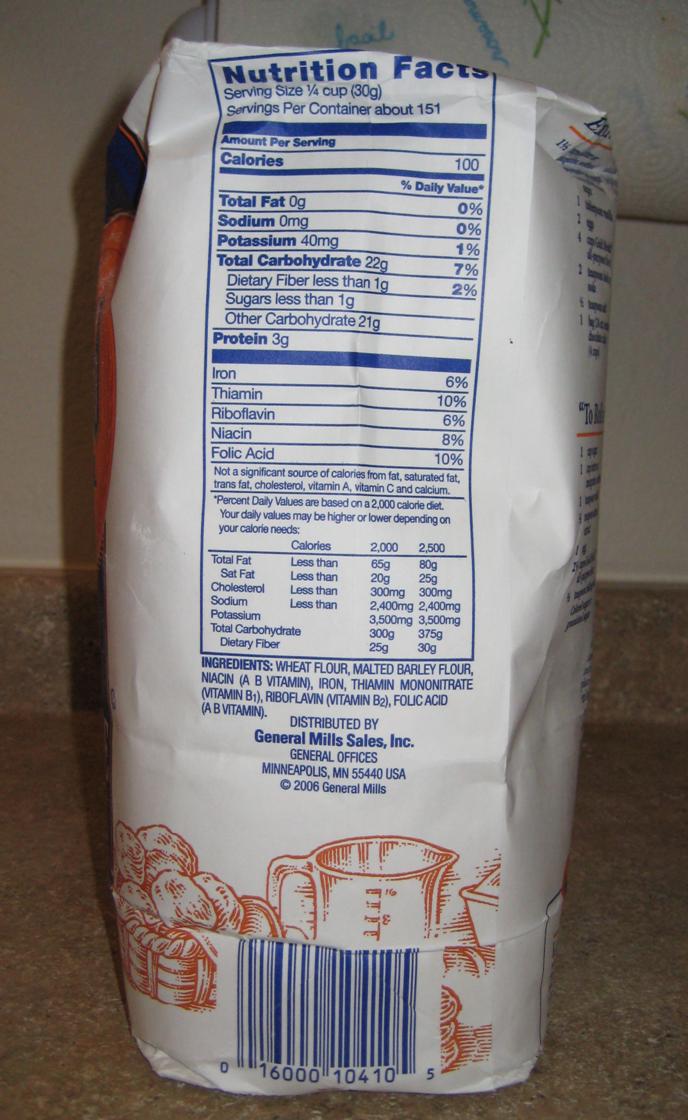
Gold Medal All Purpose Flour - label
.
INGREDIENTS: WHEAT FLOUR, MALTED BARLEY FLOUR,
NIACIN (A B VITAMIN), IRON, THIAMIN MONONITRATE
(VITAMIN B1), RIBOFLAVIN (VITAMIN B2), FLOIC ACID (A B VITAMIN).
.
http://www.lukerymarz.com/blog/images/noodle/allPurposeData.jpg
.
.
Pillsbury Best All Purpose Flour - label
.
INGREDIENTS: UNBLEACED WHEAT FLOUR, MALTED BARLEY FLOUR (IMPROVES YEAST BAKING), NIACIN, IRON, THIAMIN MONONITRATE, RIBOFLAVIN, FLOIC ACID.
.
http://www.amazon.com/Pillsbury-Purpose-Unbleached-Flour-Pound/dp/B004ZX...http://ecx.images-amazon.com/images/I/61nwqH-UvmL._SL1500_.jpg
reply by: frick on August 31, 2014 at 5:39 pm
weedsnstitches, I'm curious. Why do you avoid flours with barley in them?reply by: aaronatthedoublef on September 03, 2014 at 4:31 pm
I used to be able to get QG in stores until the boxes of the unbleached came out which is when I began mail-ordering it. I would usually wait until there was a free-shipping and then stock up. That is when I buy my KAF flours (except for bread and WWW).My local grocery has started stocking Hudson Cream AP Flour (bleached). It is produced by the The Stafford County Flour Mills Co., located in Hudson, Kansas. I found a 2 pound bag at Big Lots for $1.00 (well 80 cents, since it was a 20% off discount weekend) and bought it to try. I'm thinking that it might work well for shortbread.
Has anyone used this brand of flour before?
TUTORIAL-DEEP FRYING BASICS
Submitted by grizzlybiscuit on December 17, 2004 at 4:50 pmThis information is from the allrecipe website Advice section which I think is just great for the novice cook who has questions on basics of just about any type of cooking
Deep-frying can be a lot of fun and is a great way to cook many treats like French-fries, potato chips, doughnuts, and hush puppies. However, deep-frying can be a very dangerous process because of the extreme temperature the oil must be heated to for frying. We cannot stress enough that you should be very careful when deep-frying.1 When deep-frying, it is best to use neutrally flavored oil like safflower or peanut oil. Oils like extra-virgin olive oil have a low smoking point, which means that they will burn at a much lower temperature, making whatever you are frying taste scorched and bitter. Use enough oil so there is enough to cover whatever items you intend to fry.
2 Place the pot or pan of oil over a high heat. Heating a large amount of oil can take a long period of time. Deep-frying should be done with the oil at 365 degrees F (185 degrees C); use a candy thermometer to keep track of the oil's temperature. Oils will begin to burn between 400 and 450 degrees F (200 and 225 degrees C) and will catch fire at around 500 degrees F (250 degrees C), so it is very important to monitor the temperature of the oil. Once the oil has reached the desired temperature, reduce the heat to low. If you notice that the temperature on the thermometer begins to drop, turn the stove up a small amount until the temperature has crawled back up to 365 degrees F (185 degrees C).
3 We are making red onion hush puppies to highlight this method. To avoid splashing hot oil when dropping the hush puppy ingredients into the oil, use a long spoon and place the ingredients into the oil carefully. If you were to drop the batter into the oil from a distance, the splash would be dangerous. The closer to the surface of the oil you can get before dropping the items into the oil without burning yourself, the safer deep-frying will be.
4 The oil will begin to bubble dramatically when the hush puppy batter is placed into it. Once the first hush puppy dropped into the oil has a golden brown exterior, test to see if it has cooked all the way through. If it is golden brown on the outside but undercooked on the inside, reduce the oil's heat to about 325 degrees F (165 degrees C) and begin again.
5 Once you have determined that the oil is at the proper temperature and that you are indeed making properly cooked delicious food, add more of your batter to the oil. Be careful not to crowd the oil with too much batter. Crowding will cause the oil's temperature to drop dramatically, which will result in a greasy product. Crowding will also increase the likelihood that the fried bits and pieces will stick to each other.
6 Once the hush puppies are golden brown, with a slotted metal spoon or spatula, remove the cooked items and let them drain on paper towels or cooling racks.
7 Now is the time to season! Season while the fried items are still hot and fresh out of the fryer.
Flex your deep-frying muscles and treat your family to a delicious Blooming Onion!
TUTORIAL-BETTER COOKIES
Submitted by grizzlybiscuit on December 17, 2004 at 4:51 pmThis information will cover most of the aspects of cookie preparation and is pretty thorough.
How to Get the Texture You Want in Your CookiesCookies are a favorite goodie of just about everyone. And it seems like just about everyone has a different opinion of how cookies should be. Some people like their cookies crisp and delicate. Others prefer a chewy cookie with a thickness that you can sink your teeth into. The conundrum lies in getting the cookies you bake to have the texture you want. The exact same cookie recipe can bake up into two completely different cookies; the flavor will be the same, but the texture will be different. How, you ask? The reasons all lie within the variables of ingredients, mixing technique, temperature, equipment, and baking time.
Ingredients:
The ingredients you use are extremely, extremely important in achieving your desired cookie. Doing something as small as using baking powder instead of baking soda or using cake flour instead of all-purpose flour can make a huge difference. Even the type of fat you use in your cookie will dramatically affect its outcome. The basic building blocks of most cookies are fat, flour, baking powder and baking soda, sugar, and eggs or other liquid.Fats:
The fats most often used in cookies are butter, margarine, shortening and oil. Fats play a major role in the spread of your cookie. In other words, they help to determine if your cookie spreads out into a thin mass on the cookie sheet or pretty much keeps its original shape. Shortening, margarine, and spreads are fairly stable, so they will help cookies keep their original unbaked shape. Butter melts at a much lower temperature than the other solid fats, so cookies made with it will tend to spread out. And oil, since it already is a liquid at room temperature, produces cookies that keep their shape. The amount of fat also affects the cookies. You can basically think of it this way: More fat equals flatter and chewier to crispier cookies. Less fat equals puffier and more cake-like cookies.Flour:
Flour also affects how cookies bake and behave. Flours with a high protein content like bread and all-purpose flour will help to produce cookies that tend to be flatter, darker, and more crisp than their counterparts made with cake or pastry flour.Baking Powder and Baking Soda:
Baking powder and baking soda are the two most common leaveners in cookies. Baking soda is simply bicarbonate of soda, while baking powder is a combination of bicarbonate of soda plus an acidic ingredient (cream of tartar). Baking soda neutralizes the acidity of the dough, allowing the cookies to brown in the oven. Since baking powder already contains its own acid, it will not reduce the acidity in the dough, and the resulting cookies will be puffier and lighter in color.Sugars:
The type of sugar and how much you use also plays a big role. White sugar will make a crisper cookie than brown sugar or honey. In fact, upon standing, cookies made from brown sugar will actually absorb moisture, helping to insure that they stay chewy. Thus the reason that most chocolate chip cookie recipes contain both brown and white sugars is that you get the best of both worlds! If you lower the amount of sugar called for in a cookie recipe the final baked cookie will be puffier than its high sugar counterpart.Eggs and Liquids:
Eggs and liquids can either cause cookies to puff up or spread. If egg is the liquid it will help to promote puffiness. Just a tablespoon or two of water or other liquid will help your cookies spread into flatter and crisper rounds. One thing to remember is the different effects of egg yolks and egg whites. Egg yolks will help to add moistness whereas egg whites tend to make cookies drier. To make up for the drying effect of the egg whites, extra sugar is added. This is the reason that cookies made with just egg whites tend to be so sweet.Mixing Technique:
Cookies are not as delicate as cakes, but mixing still plays an important role. The most important step in cookie mixing is the creaming step. This is the step where the fat and the sugar are whipped together until light colored, smooth and fluffy. This helps to incorporate air into the batter, which you need if you want your baking soda and/or baking powder to work. Another important factor is not to overmix the dough. Once you combine the dry and wet ingredients, mix until just combined and no longer.Temperature:
Do not underestimate the importance of temperature in cookie baking. Cookie dough that is chilled before baking will hold its shape and produce a slightly puffier cookie. Cookie dough that is at room temperature before baking will spread and flatten out while baking. So if you happen to have a very warm kitchen, it's a good idea to refrigerate the dough before you bake it.Equipment and Baking Time:
Different baking sheets and whether you grease the sheets or not will produce different results. A good baking sheet can make a big difference. Super thin baking sheets will cause the cookie bottoms to cook faster, sometimes resulting in burnt bottoms. Yuck! Insulated baking sheets allow air movement and will help to produce puffier cookies. If you want flat crisp cookies, your best bet is the standard semi-thick baking sheets that are available just about everywhere. If you grease your cookie sheets before baking, it will cause the cookies to spread out more, but if you don't grease the sheets, you run the risk of the cookies sticking to the sheets and making a big mess. A good and fairly inexpensive solution to this is parchment paper. Its non-stick surface makes for easy cookie removal and yet it doesn't cause the cookies to spread out.Yes, it is true the longer you bake something the more cooked it will become. Cookies are usually baked from 350 degrees F (175 degrees C) to 400 degrees F (205 degrees C). Since cookies are small they tend to bake fast. A difference in temperature can completely change the amount of time you'll need to bake your cookie. If you want your cookies to be chewy, the trick is to slightly underbake them. If you want them to be crispy, bake them a little longer. The best way to do this is with an accurate oven thermometer, a timer, and your watchful eye until you get it all down.
So How Do You Want 'Em?
So now that you know a little bit about what goes into the cookie, how do you combine it all to come up with your favorite winning texture? Just follow these tips to get the cookie you desire. Don't be afraid to mix and match, your ideal might just lie somewhere between all the extremes. Start baking cookies - there's a texture to find!Flat:
If you want your cookies on the flat side, you can do some or all of the following things: Use all butter, use all-purpose flour or bread flour, increase the sugar content slightly, add a bit of liquid to your dough, and bring the dough to room temperature before baking.Puffy:
If you like your cookies all light and puffy, try some of the following tricks: Use shortening or margarine and cut back on the fat, add an egg, cut back on the sugar, use cake flour or pastry flour, use baking powder instead of baking soda, refrigerate your dough before baking.Chewy:
If chewiness is your desire, remove the cookies a few minutes before they are done, while their centers are still soft and not quite cooked through. The edges should be slightly golden but the middle will still look slightly raw. Use brown sugar or honey as a sweetener. Try using egg yolks instead of whole eggs; this will add some extra moistness to the cookies, thus helping to be a bit more on the chewy side.Crispy:
For crisp and crunchy cookies, bake your cookies a few minutes longer than suggested and immediately remove them to wire racks to cool. Cookies made with all butter and a high amount of white sugar will also crisp up quite nicely. Another trick is to use bread flour.I hope this helps....The main thing is to have fun, stay focused, have a little patience ,enjoy the journey and don't take the whole thing too seriously!
STREUSEL TOPPING
Submitted by grizzlybiscuit on October 01, 2005 at 8:48 pmThis is a simple formula--it can be used for cakes, pies, muffins, the list goes on and on! This recipe comes from Joseph Amendola (whom I had the pleasure of meeting personally). He was one of the top bakers at the school at the time I went there in '73-74. The word "streusel is German for "sprinkle" or "strew."
8 oz. cake flour
8 oz. bread flour or whole wheat pastry flour
8 oz. butter diced into small cubes
4 oz. white granulated sugar
4 oz. light brown sugar
1 Tbs. ground cinnamon
1/2 tsp. saltMeasure out both flours and mix together.
Now work the butter into this mixture with your hands or a pastry cutter until you have coarse pea size crumbs. Do not overwork the butter and let the warmth of your hands make the butter become soft! Now add the rest of the ingredients and mix well and taste the seasoning. Store this in a plastic container with a tight fitting lid and keep it in the fridge or the freezer.
People making this preparation for the first time sometimes have a tendency to want to add more butter to it because they think it is too dry. This is a mistake! You must trust the formula because if you add more butter or fat, your finished product will be greasy on top because the carefully designed ratio of flour to fat will be upset and there won't be enough flour to absorb the now added fat. I have also seen some try to use 10x sugar in place of the regular, and this won't work IMHO because the moisture content is also what makes this formula work--the 10x being too dry (you won't get those large chunks everybody loves).
You can use all-purpose flour for this recipe if that's all you have and it will work ok. You can add any other spices you like, such as nutmeg, allspice, cardamom, star anise ground, etc. You can also add nuts, dried fruits, raisins, sundried fruits (cranberries, currents, cherries, etc.) and different types of grains and seeds, such as sunflower seed, flax seeds, sesame, etc., and oatmeal or barley flakes. This is now more of a "Crisp" topping, better suited for fruit fillings. This recipe will double or halve with no problems
Topic: Spaetzle by grizzlybiscuit
SPAETZLE
Submitted by grizzlybiscuit on September 20, 2008 at 4:37 amThis preparation is most common in Southern Germany and Austria--Spaetzle, Spatzle, Spatzen-whatever you like. The favorite dishes of many to serve this with are Beef, veal, or pork goulash, Sauerbraten, pot roast, or any kind of stew really. Also in casserole with gruyere cheese or just sautéed in butter as a side dish or starch! The actual gravy from the main dish is also commonly served either as part of the noodles or alongside it. It can be added to soups, if you like, but just like minestrone only at the last minute.
All of the recipes I've found or come across have had basically the same ingredients. The mixing and cooking methods and how you choose to flavor and reheat the noodles is where all the magic comes from! I think your best formulas will be the ones that come out time after time with no surprises (take it to the bank. So keep them simple! This recipe has old CIA origins.
12 oz. all-purpose flour
6 oz. milk
4 whole grade A Large eggs (this may vary)
salt & pepper to taste
a few gratings of fresh nutmeg (don't overdo this--you should barely be able to taste the nutmeg but not have it be overpowering)Mix all the wet ingredients and flavorings together and then add the flour by hand like you would with a muffin batter. Do not overmix! Let the dough sit for 10 minutes to properly hydrate.
Once the liquid simmers, just lean the edge of the bowl over the liquid and slowly let the batter leak out. Place the palate knife flush with the edge of the bowl and tilt it slightly clockwise, and, moving back and forth, shave the batter off into the liquid. Stir lightly to make sure the noodles are not stuck together.
Once the noodles are in the liquid cook them until they float to the top and if they are small, then you can take them out. For larger, leave them in a little longer to make sure they're cooked.
With the spaetzle maker, just place a ladle of batter in the reservoir...move it back and forth over the liquid, and when it becomes empty, just add another ladle.
There are two major ways IMHO that you can toughen up these noodles. One is to overmix the dough once you've added the milk, and the other is to cook them too long in the poaching liquid! I have seen many different ways to cook these noodles, and there are three methods in particular that stand out:
1. The mixing bowl and palate knife
2. Potato ricer
3. spaetzle makerMy favorite method is the mixing bowl and here's why .This is the only true method where you can control the size of the noodles--once you get the hang of it! And also you probably already have everything you need, just the bowl and the palate knife (or icing spatula)--that's it! You just need to set up an assembly line.
a. 1 pot of boiling water or stock (the same type of set up as you would have for a decent size batch of spaghetti (if just using water then lightly salted)
b. A bowl of ice water to shock the noodles (stop the cooking process) as they are being removed from the pot when they are done You will probably need to continue to add ice to the water as you go along, because sooner or later it won't cool off the hot noodles any longer.
c. A strainer in the sink to drain the noodles once they have cooled off
d. Another container to hold all the cooked cooled noodles
e. You will need a slotted kitchen spoon or skimmer to get the noodles out of the pot
f. A container to hold the main dough
g. A smaller bowl if you have one to hold whatever amount of dough you're cooking in
each batchh. And, finally, a palate knife (the same kind of gadget you use to spread icing on a cake)
OK now for the potato ricer--not my first choice. I think it makes the noodles too small. This IMHO will cause problems in three areas. First, they get cold too fast, and they have a tendency to get greasy if you sauté them in butter. They will also fall apart if too hot or handled too much. If this is the only method at your disposal or you feel comfortable with, than by all means use it, just keep these other concerns in mind!
Next is the Spaetzle Maker. I am comfortable with this nice little gadget, but again it will produce only one size noodle, and that may be a little on the small side. It will do the job though, so we will rank it # 2. It fits right on top of the cooking pot and has a small reservoir that holds the dough or batter and pinches off the noodles into the simmering liquid as you slide the reservoir back and forth over the holes in the track. This is probably the easiest way to go while producing ok results.
You must do this in batches because by the time you got the last of the dough in the water, the first noodles would be overcooked. For each batch, putting noodles in the liquid, your time frame from start to finish should be about a minute. Be patient and they will come out a lot nicer!
comments
Submitted by Mike Nolan on Wed, 2010-10-13 11:21.
This has become our 'go to' recipe to go with several dishes, including Beef Bourguignon, Veal Zurich and Chicken Marsala.We have a potato ricer that has several different metal plates that go in it, with different numbers and sizes of holes.
The one that works best is the one with medium sized holes spaced fairly well apart. (If the holes are too close together the noodles stick together again. If the holes are too big the spaetzle are too thick and don't cook evenly.)
There's an episode of Dinner Impossible where Chef Robert Irvine makes spaetzle for a large crowd using a colander.
We don't generally fry them after they're cooked, but a really WICKED variant on spaetzle is to make Julia Child's brown-braised onions recipe (braised in beef stock), then deglaze the pan with some additional beef stock and butter and fry the spaetzle in it. (Or you can just use additional beef stock from the start and not take the onions all the way to dry.)
Submitted by grizzlybiscuit on Thu, 2011-04-14 23:52.
Another thing you can do is sauté the noodles in butter and onions ,add a tiny bit of gravy from the stew or pot roast or whatever you're cooking, and when you are about to take it off the stove ,just sprinkle on a little Swiss cheese....it makes a great side dish !SOUTHERN STYLE BUTTERMILK BISCUITS
Submitted by grizzlybiscuit on February 23, 2008 at 4:21 pmBiscuits are my favorite thing in life to eat (hence my username), and these are made with all 100% lard for the shortening, which I think makes the flakiest and most tender biscuits! It is the only way to start the morning down here in the South!!
The recipe may seem a bit large, but it will yield about twelve to fifteen 2 1/4" biscuits. As with all recipes on this site, I think they should be looked at as guidelines. If you have good results but you feel you could be a little happier with them by all means don't be afraid to tinker a little with the recipes and make small adjustments!!
about 18 oz. of White Lily or All Purpose flour
you can also try 12 oz. White Lily/6 oz. Whole grain spelt flour
(If using self-rising flour eliminate the baking powder & salt)
1 Tbs. baking powder
1 tsp. baking soda
1 tsp. saltIf your kitchen is very warm at the time you are making your biscuits, I usually put the whole bowl into the freezer for about 15 minutes to chill all the dry ingredients.
5.5 oz. very cold lard or a combo of butter & lard: 1/2 & 1/2
approximately 14-16 oz. cold buttermilk
egg wash: 1 whole egg + 1 Tbs. milk beaten1 pastry brush
1 mixing bowl for the dough (about a 6 quart size) or similar containerMeasure out flour, baking powder, baking soda, salt, and set aside. Mix all the dry ingredients together, and add the lard. Now work the lard into the flour with your fingertips, until it all looks like one consistency without overdoing it.
Preheat your oven now to 425 degrees for 15 minutes.
While the oven is heating up, measure out the buttermilk, and prep your baking pan with parchment paper preferably.
Now add your buttermilk to the dry ingredients, holding back a little just in case you don't need it, and mix it all together very gently!!! This dough should be very moist!
To portion out, just have some hot water on the side and use a medium ice cream scoop* (#20-24) onto a parchment lined cookie or baking half sheet pans.
Bake for 12-15 minutes until golden.
*I used to use a biscuit cutter, but this method is soooo much easier with much less mess to clean up after.
SMOOTHIES -BREAKFAST
Submitted by grizzlybiscuit on June 28, 2006 at 4:38 amYou can make this in the blender in a snap. It's a great way to use up over ripe bananas and any other fruit you want to use up! You can keep switching out the fruits as the seasons pass! It's low in calories and fat and full of vitamins and minerals--the perfect way to start off the day!!
This recipe will yield about 5-6 portions (a 5-6 oz. glass) and hold up in the fridge for about three days!8-10 oz. orange juice
1 8 oz. carton of your favorite low-fat yogurt
1 large banana or 2 small ones
about 5 or 6 rinsed and hulled fresh strawberries
1 Tbs. of honey or agave nectar
1/4 cup toasted wheat germ
1 tsp. vanilla extractPlace the strawberries in the blender first, so they puree up nice, then add all the ingredients at once and blend on medium speed for about 2 minutes. Then kick it up to high for about another minute.
If you don't get too crazy with the substitutions, an 8 oz. glass for breakfast is less than 500 calories. I use Tropicana Essentials Orange Juice, which is 1/2 the calories, sugar, and carbohydrates--great for diabetics also! Still tastes pretty close.You can adjust the thickness by either adding another banana or some more orange juice, whichever direction you're going in.
Substitutions & other add ins:
You can sub kefir for the yogurt
Fresh ground flax seed for the wheat germ
a small amount of fresh mint
when in season: peaches and/or raspberries, with a pinch of cinnamon
blueberries with a couple drops of lemon
mangoes--add some lime juice and or cilantroSAUSAGE GRAVY
Submitted by grizzlybiscuit on November 06, 2005 at 3:01 pmSausage gravy and biscuits are all about simplicity! Chopped sausage bound together in a white cream sauce with lots of black pepper....One of America's finest breakfasts!
1 12 oz Package of Jones All Natural Pork Breakfast Sausage (small links, no artificial ingredients), cooked and chopped coarsely but not too big (net weight 7 oz), with fat drained and reserved (for the roux)
2 cups (16 oz) of regular milk
2 Tbs. rendered sausage fat
3 Tbs. all-purpose flour
kosher salt to taste
lots of black pepper (10-15 grinds from a fresh mill)4 hot fresh biscuits opened in half--you should have plenty for 4 people
Place the sausage in a pie tin (9") and cook it off for about 20 minutes at 375 degrees. Drain off all the sausage fat and save! When cooled, chop up the sausage coarsely (not too big) and set aside.
Mix together 2 Tbs. of the sausage fat with 3 Tbs. of all-purpose flour & cook on the stove under high heat, constantly stirring with a wooden spoon long enough to get it smooth & bubbly. Set aside.
Scald the milk in a separate pot, and then slowly add about half of it to the prepared roux and stir vigorously with a wire whip until smooth. Now add the rest of it to the milk and stir vigorously until smooth and adjust for thickness.
At this point cook for a few minutes on moderate heat to cook out the raw pasty flour taste and adjust with a little milk or a little more roux to get the right consistency The sauce should be a little on the thick side.
Now add back in all the chopped sausage. Season with a little kosher salt and lots of black pepper.
Pour a generous portion over the opened biscuit. Don't add anything else; this is all you need!
TABBOULEH SALAD
Submitted by grizzlybiscuit on March 30, 2005 at 3:38 pmThis is a long time Mediterranean standard served in many parts of the world. It is very heathy and demands all the freshest ingredients available! It is usually served cold as a salad alongside toasted Pita chips and other flatbreads or just by itself! It is a refreshing change in the hot summer weather! It has also been served with whole leaves of romaine used to dip into the salad.
1 cup bulgur wheat
2 cups boiling water or stock1 28 oz. can of diced tomatoes in juice
1 small to med red onion diced (1/2")
juice and zest from one large lemon
1/3 cup virgin first cold press olive oil
1/2 a bunch of flat leaf parsley chopped
1/2 a bunch of fresh mint leaves chopped
kosher salt & fresh ground black pepper to taste
1 tsp. honey (To take a little of the edge off of the lemon and balance the flavors)Optional:
8 oz. small diced ham
1 cup of fully cooked hard red winter wheat berries
1/2 cup thawed blanched whole kernel corn
1/2 cup thawed blanched green peasDrain the diced tomatoes and reserve the juice.
Put a pot of water on to boil & add the reserved tomato juice and enough water to equal about 1 quart. Add some coarsely chopped onions, celery, carrots and a couple of pieces of garlic (about a pound total for all three) and any herbs you have lying around (a couple of bay leaves, some thyme leaves, and 10 whole black peppercorns), and simmer it all for 30-45 minutes. Strain.
Measure out 2 cups of the stock and pour it over the cup of bulgur and let soak for 45 minutes to an hour covered in plastic on the side.
Drain off any excess stock if there is any, and place the now cooked or fully hydrated bulgur into a large mixing bowl.
Now dice the red onion and chop the parsley and mint; add this and all other ingredients together with the bulgur and toss lightly. Cover and refrigerate until completely chilled or overnight!
The amounts for the lemon juice and olive oil are guidelines; add more or less to your liking.
This dish is usually served without any kind of meat, but I like to throw in the diced ham and the peas and corn for color and flavor.If you don't have the canned diced tomatoes, you can just dice some fresh ones.
The wheat berries must be soaked overnight ahead of time and then drained, rinsed, and simmered for about 1 1/2 hours or until done . Drain them and chill. Do this 2 days before you make the salad.
You can use whatever kind of fruit juice you like: lime, orange, apple, cranberry. You can add walnuts with this, etc. Lemon is classic.Or you can add Balsamic vinegar, cider, rice wine, red wine, or any other type of vinegar you like in place of the juice!
Mint leaves are classic and IMHO very hard to replace here, but if you really like a different type of herb, then go for it!
You can use the remainder of the vegetable stock if there is any to just steam veggies on the stove in a frying pan!
REESES PEANUT BUTTER CUPS-GRIZZLY STYLE
Submitted by grizzlybiscuit on March 25, 2005 at 2:36 pmI got the basic idea for this recipe from a pastry chef I worked with on Cape Cod back in the early eighties. His nickname was "Sweetman." The only word that comes to mind concerning this recipe is complete submission and loss of control (knowing when to stop)....lol. I don't eat this stuff anymore because of my new medical concerns, but, as you all know, the reactions of others and their comments make it all seem worthwhile!
graham cracker crumbs
canola oil spray1 13"x18" jelly roll or 1/2 sheet pan
2 cups creamy peanut butter
1 pound (room temperature) unsalted butter
3 cups 10x sugar (only a guideline)
2 tsp. Vanilla Extract (pure)
Salt to taste (1/2-1 TSP)
8oz bittersweet chocolate
4-6 oz. semi-sweet chocolate
1 oz. soft unsalted butter
1 oz. heavy cream
Grand Marnier to taste (optional)Spray your jelly roll pan with the canola spray and dust lightly with the graham cracker crumbs and place it in the freezer.
Cream together the peanut butter and the soft butter until light and fluffy (about 3-4 minutes) in a 5-quart bowl of a stand mixer with a paddle, if you have one.
Slowly fold in the sugar, vanilla extract, and salt. You can experiment with the amount of sugar according to your own taste. Mix on medium speed for another 3-4 minutes.
Empty the contents of the bowl with a plastic spatula into the pan and tap the corners on the counter to evenly distribute and smooth out the filling. Put back in the freezer to set (about 2-3 hours)
Set up a double boiler and melt both chocolates, butter and cream and whip until smooth, and set aside.
When the filling is set, remove it from the freezer and spread the Ganache type chocolate mixture evenly over the top. (You have to move quickly here because the chocolate will start to set up almost immediately as soon as it hits the cold peanut butter.) Put back in the freezer.
After about a half an hour, pull the pan out briefly and take a small sharp knife and score the pan with 6 rows x 8 to yield 48 2 x 2x 3/4" pieces.
These little fat monsters will not behave too nicely in the heat, so leave them in the freezer until about 20 minutes before service. This is a very rich dessert so they don't have to be very big.
You might be able to substitute low fat cream cheese for the butter in the recipe and grind your own peanut butter. This filling is now good to go for peanut butter pie, although you might have to adjust the sugar and salt and fold in a little "Cool Whip" as low fat preparations are generally much higher in sodium content.Betcha can't eat just one!!!