We had tuna salad tonight, I made a big batch of hard boiled eggs so Diane can make deviled eggs to take to the Halloween pot luck at her office on Thursday. I'm also going to experiment with a batch of ossi de morti cookies (rather than pan de muerto), modified to make it more keto-friendly.
I've used the mini-scone pan, generally about once a month, or 10 years, I think. It takes a little more time to fill the "wells" than it takes to pat out the dough and cut into whatever shape(s). However, the size is great for portion-limiting. I use the cookie size scoop, then the back of a spoon to fill the corners. I feel it is well-worth the expense. Are you looking for other ways to use the pan? I suppose you could use it to bake triangular cupcakes? I'm sure others here can come up with more ideas!!
Left over pizza, plus a salad (for me) and a small slice of apple pie.
The dough filled the bottom mold, so I was hopeful. I weighed it down with an iron griddle with a handle (handle was a mistake). When I moved it to the oven, the top was already trying to come off. Eight minutes into the bake, it popped the griddle off and tipped. I was able to remove the top, put the griddle under those spindly legs, which I should have done in the first place, and put the righted loaf back in the oven. The top does show where the pan slid, so the pumpkin is lopsided, but it had begun to take the indentations of the mold before I lost the top. Because of the depth of the bread, it took about 65 minutes to bake to 190 F. I covered it for the final 10 minutes with foil because the part outside of the mold was overbrowning.
What I would do next time: Use 50 grams less dough. Put the mold on the flat griddle so that it will be stable. Weigh down the mold with the lid of my large Le Creuset pot. That way the weight is directly on the entire mold. Ideally, there would be some kind of clamp to hold the two parts together. I'll give some thought to whether I can rig something that would work.
The side that was on the bottom is beautiful with lovely indentations, the other side is, as I noted, a lopsided, overbrowned mess.
It looks like one of those unfinished sculptures where one side is beautifully detailed and emerging from an uncut stone.
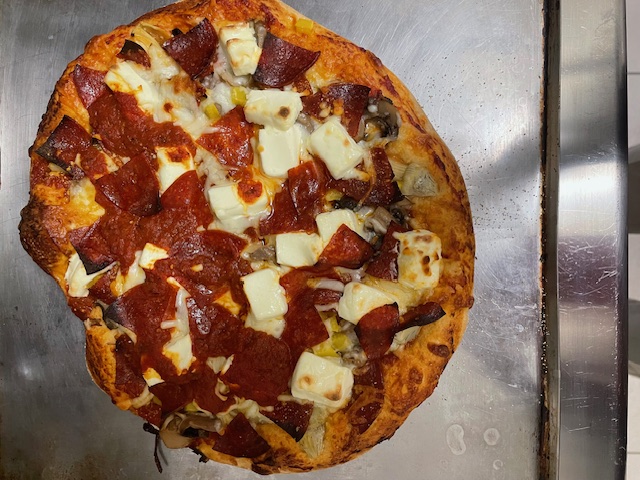
We had pizza again tonight. We had tickets to see The Capital Steps last night, they were funny--as usual, so we postponed pizza night until Saturday.
Biggest difference was I baked this one directly on my 14" pizza steel, so the crust is a lot crisper on the bottom. (I couldn't figure out how to get a good photo of that.)
Worked fairly well, I'll do that again.
Attachments:
You must be
logged in to view attached files.
I figure my lasagna is well over a dozen layers, (3-4 layers of pasta, plus layers of sauce, multiple types of cheeses including a ricotta/spinach blend, meats, and mushrooms.)
I tried counting the layers of pasta in that picture and came up with around 30, which means something like pasta-sauce-cheese-pasta repeated around 30 times.
As Len says, mostly for show, sort of like the 12 pattie 'special' at In-N-Out. People can order it, and even eat it, but is it a gustatory experience worth repeating?
There's not a lot of research on how a frozen starter that is re-established compares to the original, though being able to rebuild a lost starter is the point of the Puratos Sourdough Library, where they keep sourdough samples frozen (including a portion in liquid nitrogen, I think.)
Prof. Michael Ganzle's writings, though, seem to support the concept that a starter is largely a product of its feeding and handling, ie, how often you feed it, what you feed it with and how it is stored in between feedings. His research suggests that regardless of where a starter is (US, Europe, Africa, Asia) starters that are maintained using similar processes are remarkably similar in terms of their microbiological makeup, ie, what strains of yeast and bacteria wind up dominating the culture. (Refrigerating vs room temperature seems to be one of the key differences, and IMHO is the primary difference between a commercial bakery's sourdough starter and most home sourdough starters.)
If that is true, then whether you re-establish a frozen or dried starter, or one that got lost in the back of the fridge, get some starter from another baker or start from scratch, you're likely to end up in a similar place in 6 months to a year. And that's not a bad thing if you have a sourdough starter you're used to maintaining and using.
Aaron--I think that Joan's advice is excellent. I also have never frozen starter, but I seem to recall that at one time that was featured in a thread on the Baking Circle as a way to preserve it if someone was going on an extended trip away from home. I don't know if it is among the threads that were saved here.
I have a milk-based starter, and it does ok if ignored for a month or longer, but I find, like Joan, that it takes a couple of feedings (and using what I take out for crackers or pancakes) before the sourdough is strong enough to work without any yeast.
I just looked at all the saved threads, and I don't think the sourdough thread made it to Nebraska Kitchen from the Baking Circle.
I am baking the bread in the pumpkin mold today. I decided to use my recipe for "Mostly Whole Wheat Maple Buttermilk Bread, as I recalled that I bake it as two smaller loaves (7 1/2 x 4-inch) with a dough amount close to what Mike suggested. That recipe has too much dough for two 8x5 pans but not enough for two 9x5 pans. It fits perfectly in a 10x5 pan. Each side of the mold is about the size of one of the 7 1/2 x 4-inch loaf pans.
The dough weighs 1450 grams. It fills the lower mold. I've put the other mold on top and weighted it down with a flat iron griddle. It is now on its second rise. After an hour, without looking at it, I will bake it and report back. This bread recipe has fantastic oven spring, so I am hoping for a great result. If it comes out well, I will try to post a picture.
Yes, those brownies meet my definition of health food! They have whole grain (oats) and calcium!
I agree that one can never have too many sheet pans of various sizes. I like the heavy ones.
I got a USA quarter sheet pan today (you can't have too many quarter sheet pans) so I decided to try it out, just to make sure it works, plus I had a box of brownie mix that has an Aug best date that I wanted to use. As I often do, I added a half cup of oats soaked in a half cup of milk. Plus, I replaced part of the oil (used walnut) with buttermilk. If those modifications don't make it a health food, then I don't know what health food is! I usually use a 9x9 aluminum pan for brownies, they baked up pretty fast in the quarter sheet pan, 25 minutes.
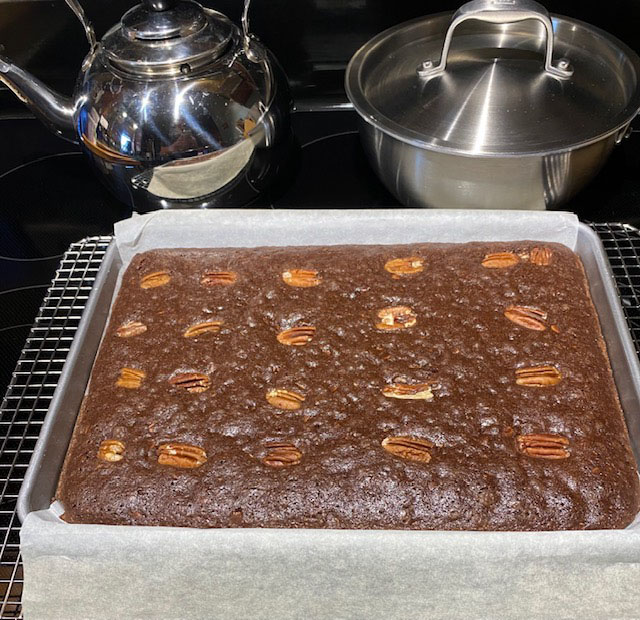
The USA pan is fairly heavy at one pound 12 ounces, as compared to my Nordic Ware aluminum pans at about one pound.
Attachments:
You must be
logged in to view attached files.
Hi,
I've had my starter in the freezer for a while (I forget how long). I thawed it out and it is a soft solid.
Have any of you revived starter? Should I add water and mix? Should I take some and mix with water in a new, clean jar?
It has a strong, sour smell so I'd like to get it going. It will make some good sourdough.
Thanks
I've been a little lazy about posting here this week.
On Monday I made a small, easy lasagna. I made it in a pyrex baking dish. I used the no boil noodles, 2 to a layer with some overlap. Sauce was from a jar, I had some ground beef that I had cooked a couple of days prior. I used Ricotta cheese that I mixed in a little oregano and parsley flakes. I used 4 layers of noodles. When it was almost done I uncovered it and topped it with some mozzarella and finished it on the convection mode (the pan was too full to top it with the mozzarella and cover it from the outset). It came out good.

Yesterday I bought a rotisserie chicken and made tostadas and had it with brussels sprouts.
Tonight will be chicken with mashed potato, veggie to be determined.
Attachments:
You must be
logged in to view attached files.
Over 20 years ago, I bought a two-part cast aluminum pumpkin mold from King Arthur. It came with a recipe for Malty Wheat Bread. I eventually tried the recipe a couple of years later, but the dough did not come close to filling the pan, so it was a one-sided pumpkin, with good texture and taste. I never got around to trying the recipe again, although each autumn, I would see the mold with my other fall baking items. I did not recall where the recipe was. I was not on the King Arthur Baking Circle at the time, as I was unaware of its existence, so I did not troubleshoot the recipe, and King Arthur was no longer selling the pan.
I found the recipe the other day while trying to clean out some files, and I had written my notes on it. I now have more baking experience, and my first thought is that there is not enough dough to fill the pan completely. I measured the halves. The larger half is about 5 1/2 cups, while the smaller side is about 5 cups.
Here are the recipe ingredients:
1 1/2 cups water
2 cups King Arthur AP flour
1 1/2 cups King Arthur whole wheat flour (white or traditional)
3/4 cup malted wheat flakes
1/4 cup malted milk
2 Tbs. molasses
2 Tbs. oil
2 tsp. instant yeast
1 1/2 tsp. salt.
I am thinking that I need a recipe with at least 6 cups of flour in order to fill the pan. I'd like to get feedback from people here at Nebraska Kitchen as to whether I am on the right track. I'm thinking that a recipe that fills a 10 x 5 loaf pan might be the way to go.
Further Note: The pan is not made the way the traditional lamb pan was made in that the top does not fit into the bottom section but merely rests on top. I would probably weight in down with a cast iron skillet, which I also do with the lamb cake pan. I might also need to put it on a lower shelf, as it is on spiked legs, which are also on the top part, probably so that one could just bake a cake in it as two halves.
This recipe is one my wife's grandmother made, especially at Christmas. We have tried it several times and my wife was always disappointed with the results. I suspect the sour cream her grandmother was using was cream from the farm that had gone sour. Creme fraiche or soured heavy cream might work better than cultured 'sour cream', which has a lot less fat in it.
Yield: 2 10 x 14 pans
Mix together and proof yeast for 10 minutes:
2 packages yeast
1 teaspoon sugar
1 teaspoon flour
1/2 cup warm water
Dough:
1/3 cup sugar
1 teaspoon salt
1/3 cup shortening
2 eggs
4 1/2 to 5 cups flour
3/4 cup milk
1 tablespoon orange juice
Topping:
2 cups very thick sour cream
3 cups brown sugar
2 teaspoons cinnamon
2/3 cup fine bread crumbs
Mix sugar, salt and shortening. Combine eggs, 2 cups of flour, milk and orange juice and mix well, then add yeast and mix well again. Add remaining flour and knead for 5 minutes. Allow to rise in a warm place until it has doubled (about an hour), then punch down and allow to nearly double again.
Preheat oven to 375.
Divide in half and roll each half out to fit in a 10 x 14 pan. Let rise for 10 minutes then press edges of dough into sides of pan. Spread topping on dough and sprinkle with bread crumbs. Bake 20-25 minutes or until light brown.


