aaronatthedoublef

Forum Replies Created
-
AuthorPosts
-
Crumbl is opening here. They are building out in the same shopping center and the bundt cake franchise store.
Thanks BA. My parents bought some challahs (the actual plural is "challot") but most of them were made by my mom sometimes with a little help from me.
To your point about inspiring others, we're starting with a dozen to see if we can make the logistics work. But if this is successful and the delivery folks can handle it I think I can make 24 on my own provided I can find an oven to handle that. If I can inspire some people and this grows then I can rope some people to come in at 4:00 am to shape. Or if I can just convince people to make their own and make an extra loaf to give away, this will have been a success.
I want to try your oatcakes but I need to find Scottish oats. All I can find here is steel cut and rolled. I may try to order some or I could probably grind some steel cut in the blender.
Matt used spelt a lot in the bakery. For a while it was really inexpensive. He was always switching around trying to keep good flavor and margins without raising his prices.
Mike - You are right. I need an NFP. The I can buy wholesale and there are a number of places to do that around here. Back when my restaraunt friends bought bread flour for $15 for 50 lbs. they would give me bags. But now it is just too expensive.
First, thanks for all your wise counsel and for being my sounding board as I embark down this path. I cannot tell you how much it means to me.
I made challah. Six loaves and no rolls this time. I'm getting the process down and my braiding is getting better but it is still not where I want it.
I tried raw honey from Costco to replace the local honey I use normally. It's not as good but my testers didn't notice the difference. I do but I suspect that is because I know it is different. The local stuff is four or five times as expensive and food costs start to add up. I'll need between 8-10 lbs of flour a week. Even if I buy BRM bread flour from Vitacost which has the best price around here, that's still $12 just for flour. I'll use 10-11 eggs and we all know about that. I need to setup a 501c3 and that will help me contain some of those costs.
My distribution is shaping up too. I have people who will pick up the bread at our temple and deliver it.
If you're wondering why I'm doing this with challah (aside from the obvious) is that we have some very generous bakeries here who donate day old bread. And with many of their loaves the flavor actually peaks probably 12 to 24 hours after it comes out of the oven. So day-old may actually be a better product.
But challah on Saturday is too late. So if I can get this to people before sun down Friday they can have challah for the Sabbath.
Thanks everyone.
According to Bing Chicago Metallic sub roll pans can be found at a Sysco about 10 miles away from my house. I'll check to see if they actually have them. There are other ones available on Amazon but I haven't looked to much. I need a couple full size sheet pans and a couple of BIG bowls for challah so I can do this all in one trip.
I still like a couche because I can use it for this or baguettes or other things then brush it, fold it, and slide it away.
I used a flip board at Uncle Matt's. It's pretty neat how something so simple can make a big difference.
Looking online I can find sub roll pans but not the Chicago Metallic. I bet I can on eBay. But I'd rather just form these by hand.
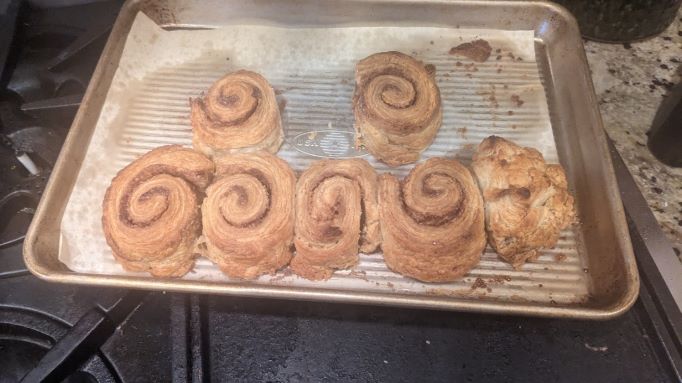
I had biscuit dough in my freezer and needed to free up space so I turned it into cinnamon buns.
My family said "too buttery". Of course they have eaten this dough many times in other forms. I used turbinado sugar instead of white and I needed more of it. It lacked sweet.
The layers looks pretty good and they survived in the freezer pretty well too.
Have any of you ever tried mixing maple syrup with cinnamon and using that?
Thanks
Attachments:
You must be logged in to view attached files.Add croissants to this list. Here in southern NE (I'm including Boston) bakers can't just leave a croissant alone. They load them up with all sorts of stuff. The most extreme I've seen was a baker who makes beautiful, wonderful, croissants fill them with pastry cream with fruity Pebbles in them for Pride Month. There is something to be said for simplicity and purity and a plain croissant is just wonderful and a cup of good coffee.
The sad part is his plain croissants are great.
Most of the bakeries I know have crappy cookies. The same baker who made the fruity pebble croissants said it is because he has to make cookies and doesn't really care about them. But they are the worst item he sells.
If you load up a cookie with peanut butter cups and buttercream and all this stuff then
you can hide a lot of mediocrity.Good cookies just don't need all this junk.
Thanks Mike. Thanks BA. I'm am out of space for new pans and I still need a couple of full size sheet pans. I may invest in a couple of couches. I can fold those and they take less space.
Mike, I did try to shape these like baguettes. Instead of a proofing board I used the back of a half sheet and I know I did not flour it enough so it was hard to take them of the pan and onto the stone. Thinking about this as I type, I could have just put the whole pan into the oven... As Homer Simpson's baker brother said "dough!"
I made my sandwich loaf and then tried to make sub rolls and they looked more like Olive Garden bread sticks. So I need some work there. Have any of you made sub rolls?
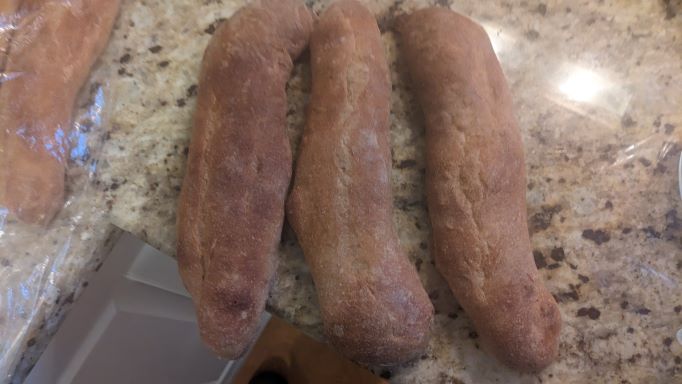
Also, as I've tamed the sour the bread seems flat, like it needs salt. I may add some herbs and see if that helps. Salt is about 1.5%
Attachments:
You must be logged in to view attached files.On the Kids' Baking Championship on they had "Over the Top Cookies". First they wrecked cupcakes, then doughnuts, then cookies.
There is something to be said for a simple, well made, chocolate chip cookie. Or oatmeal cookie. Or, what seems to have become our family cookie, molasses (even though Mom called them ginger snaps).
As Choco says, if they're made with good ingredients they will taste good. Who needs all this junk on top of them.
BA, next time I will try to wet may lame, especially if it isn't working. And it was a brand, new blade.
So, challah originated as a separation of dough to be sacrificed. The batch of dough, according to modern rules, needs to be five pounds to be kosher.
A rabbi gave me an unstructured dump of info I am still working through and this is just the tip of the iceberg. I think I could easily write a PhD thesis on challah.
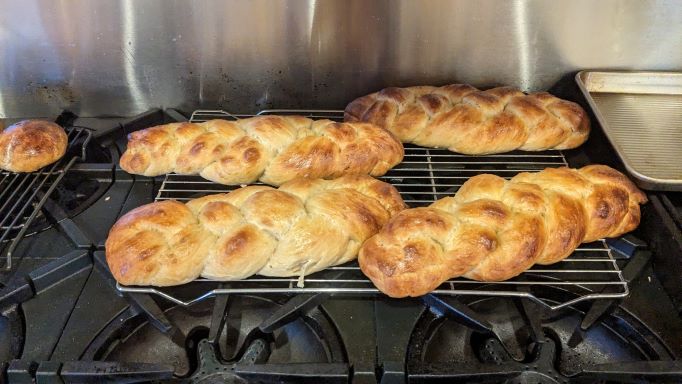
February 26, 2023 at 11:00 am in reply to: What are you Baking the Week of February 19, 2023? #38556Thanks Mike. I definitely neglected the challah after braiding and they flattened out during baking. You can see it inside. I also put two half sheets with two loaves a piece in the oven. I usually only do one pan at a time so I may need to raise the oven temp some to account for this.
Two loaves of challah is a lot but not in my house, even with Sam at school. 😉 And Violet will not even try it.
I did track down why there 12 loaves of challah comes from. It's in Leviticus. I know the two challah tradition. I'll find where that comes from. For a long time most challah recipes were big because batches were supposed to be at least five pounds. My first recipe I followed called for seven cups of flour and easily overflowed my mixer. Same thing happened to my mom.
Thanks everyone.
Mike, I'm not sure how to tell if they're over proofed or what to do about it if they are.
I made some regular sandwich bread and may have over-proofed it as well. I increased the hydration from 70 to 75%. The dough was too soft to score which I've never seen before.
I did get a good oven spring and the crumb is a little more open than usual which is what I wanted. It's lighter and softer.
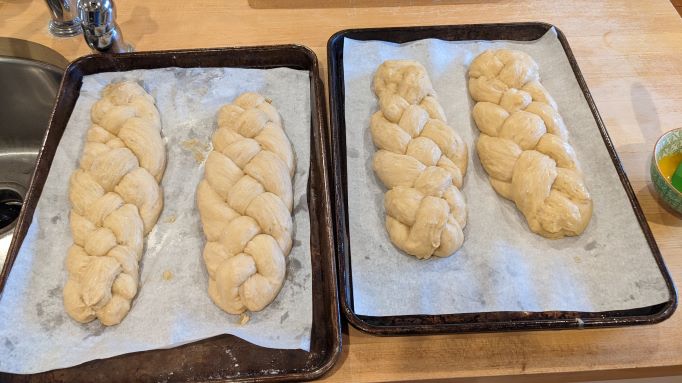
Back to challah. I made enough dough for six this week and realized that to get to 12, to paraphrase "Jaws", I'm gonna need a bigger bowl!
I can bake at least eight at one time and maybe 12 if I use full sheets instead of half. I'm also working with my temple to give them away. I tried a couple new braiding techniques and I'm still doing four strands.
I have the date wrong on the baked challahs. And I really do need to start the dough on Thursday night instead of early Friday morning.
Attachments:
You must be logged in to view attached files.Mike, the color and crumb look good. Free form shaping is so much harder than I ever anticipated. It took me about six or seven times at Uncle Matt's before I was happy with my batards and my baguettes were still hit or miss. And you all have seen some of my wonky challahs.
I have to make sandwich bread and challah and pizza dough this week.
-
AuthorPosts
