Mike Nolan

Forum Replies Created
-
AuthorPosts
-
We got a big bag of spinach at the farmer's market on Sunday that we need to use up, we're thinking about blending some into some pizza sauce. (I often blend spinach and ricotta for lasagna or a stuffed pizza, I don't know if that would work in pizza sauce, but I think I'll try it on Friday, which is often Pizza Night here.)
I don't refrigerate pan grease, either, but I have had it go moldy once. I usually have to stir it down because it has separated a little in between uses. (I don't use it a lot.)
I'm making semolina bread again today. We've reached the time of year when bread goes moldy a lot faster, and we've been eating a lot of breads other than the semolina bread lately (challah, pumpernickel, Boston Brown bread, etc.) so I'm probably going to cut these loaves into 3 parts rather than 2 for freezing.
I had some salad, my wife had a fried egg.
4-6 weeks without baking would be a challenge here, though I do have a few breads I make that require little mixing or that I knead by hand.
A food processor, a cheap mixer or bread machine from a second-hand store, maybe?
I'm not so sure about the pumpkin part but maple syrup instead of molasses would make an interesting change, I'd expect it to be sweeter, as molasses has a slightly bitter undertaste, depending on what type of molasses you use. Not sure if using maple syrup would change recommended baking time/temperature.
We had a stir fry tonight.
Yeah, it hit 91 here today, but tomorrow's high is supposed to be 78, then down to the 60's for a couple of days. A regular roller coaster.
It used to be a pretty safe bet to plant tomatoes in the garden on Mother's Day here, but in the last 10 years we've had 5 with temperatures in the 30's and wind chill in the 20's after May 15th, so I'm not in a big hurry to plant outside. The years it didn't get super cold it often rained for 2 weeks in late May making it hard to plant anything until the soil dried out some.
I was able to get some chelated iron online (none of the local garden supply places stock it) and I added a small amount to the watering liquid on Friday. Most of the plants are looking better already, but I had cut back on the water in the tray early last week, so that may have been a major factor.
Six of them (including one that grew from a seed that didn't get into a pellet pot) had gotten large enough that they were crowding out the light from the littler ones, I've moved them to separate 3" peat pots under another grow light and that should give the smaller ones more space (and better light) to grow. I think I was able to save enough of the roots of the one that wasn't in a pellet pot for it to survive, and I think I know what variety it was, too.
I'll continue to move the bigger ones to their own pots over the next several days, I need to set up another rack up with some grow lights.
The main reason I switched to the Pullman pan was because I was concerned the batter would overflow my 8 inch bread pan, but at this point I like the size of the resulting bread and the next time I bake it I will use the Pullman pan.
I did put a pan of water on the rack below the Pullman pan, just to make sure the oven was fairly moist. Don't think it is necessary when using a Pullman pan with a lid that seals fairly well, but it certainly didn't hurt things.
On my list of things to try at some point is a rye recipe (not one in the Ginsberg book) that is supposed to be baked/steamed for many hours in a double-walled lidded pan with water in the outer layer. I can't find such a pan anywhere, but I think if I use my big Pullman pan and put it in my big roaster with water in the bottom and the lid on the roaster, that may be close enough.
Baked beans and brown bread is not a low-carb meal, that's for sure, but it was tasty!
The first time I made Boston Brown Bread, I think I used a jello mold, the second time I used a stainless steel utility crock, but I really like the shape I got from the Pullman pan, it made it easy to slice, too.
Report on Boston Brown Bread (Ginsberg pps 90-92):
This is a quick bread not a yeast bread, though it seems odd to describe anything that bakes for 3 hours as 'quick'.

The recipe said to bake it in an 8 inch bread pan, but the dry ingredients alone nearly filled up that pan, and I was concerned that after I added 2 cups of milk and 3/4 cup of molasses that it'd spill over the top, so I put it in my 4 x 4 x 13 Pullman pan. It has a lid so that simplified sealing it in the pan, too.
I forgot to weigh the finished bread.
I did put a pan of water below the bread just to make sure the air was a bit steamy.
I like the fact that the slices are 3 x 4, which is a good size for a slice. If I make it again (and that seems likely), I'll do it in the Pullman pan again.
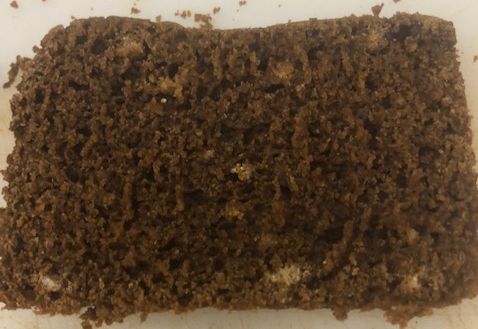
Doing it in a sealed pan is a lot simpler than trying to find a way to steam it, and the taste is very good. We had it with Boston Baked Beans, and it was a great pairing. (That pairing, as I recall, gives you all 9 amino acids, which would make it a complete protein source.)
I tried a slice with some cream cheese, it totally changes the flavor profile of the bread. I liked it, my wife wasn't as fond of it that way. I don't know how well it would toast, it might fall apart in a regular vertical toaster.
Attachments:
You must be logged in to view attached files.At dinner last night, we got to talking about the rye project, and specifically Boston Brown Bread.
I hadn't really looked at Ginsberg's recipe, he doesn't put the loaf in a pot to steam, but he does have you seal it in the pan with foil and bake it at 200 degrees for 3 hours. I've made Boston Brown Bread twice, the biggest challenge was figuring out how to steam it.
This may be the next Ginsberg recipe I try, Boston Brown Bread and Boston Baked Beans for supper tomorrow sounds good to me.
Tonight we had leftover pizza and some salad.
My guess is you could simplify the recipe, maybe make a simple flying sponge with 50 grams of flour, 50 grams of water and 5 grams of yeast and let it sit for an hour or two. I like the idea of having both white flour and whole wheat flour, I think whole wheat would add good texture and flavor to pita.
Peter Reinhart has a recipe in American Pie for carta di musica pizza crust that behaves like a pita, you bake the dough on a stone long enough for it to puff up like a pita then take it out before it starts to get brown or crisp, let it cool (it will deflate), separate it along the outside edges into two pieces, and use it as the crust for two pizzas. If one part comes out a bit too thin, he suggests baking it further and using it as crackers. I haven't tried this yet, though.
-
AuthorPosts
